Laminitis in horses: early signs and first steps
What happens inside the hoof in laminitis, where it comes from, how the early signs look, what to do before the vet arrives and what you must not do.
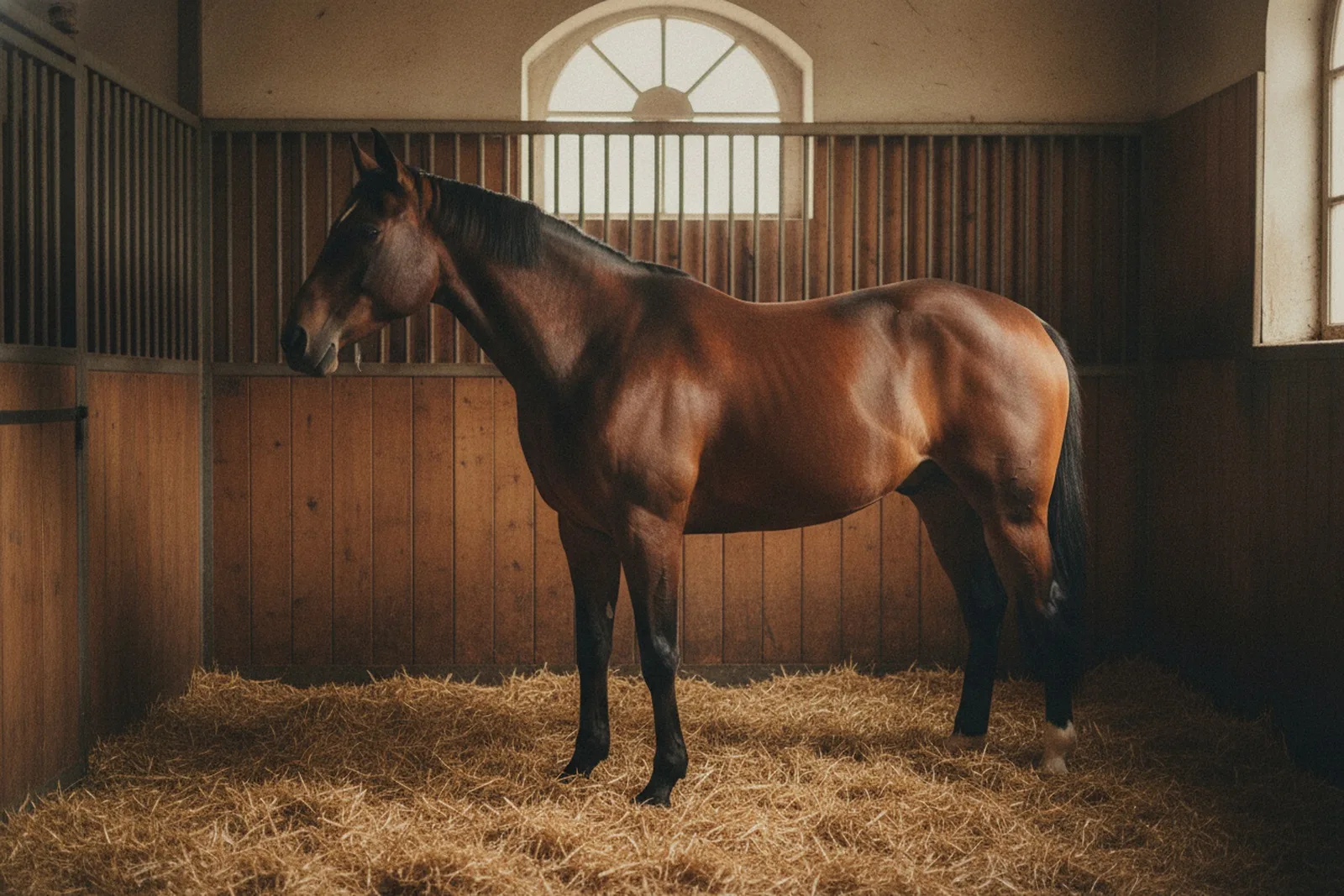
Laminitis is inflammation of the laminae inside the hoof. It is not a hoof disease in the narrow sense: the foot is only the place where the pain becomes visible. The cause is almost always metabolic, dietary or systemic.
It starts quietly. That is exactly why it is usually caught at the second stage, when rest alone is no longer enough.
What happens inside the hoof
The coffin bone hangs inside the hoof capsule. It is held there by the laminae: thousands of interlocking leaves bonding the wall to the bone. That is the only attachment. There is no bony support from below.
In laminitis the laminae inflame and lose their grip. The attachment weakens and the weight of the horse does not go anywhere. Two things can follow:
- Rotation. The coffin bone tips toe-down, pulled by the deep digital flexor tendon. The sole bulges at the toe.
- Sinking. The whole bone drops within the capsule. A worse prognosis than rotation.
Both are visible only on radiographs. In the first hours a mild case and a catastrophic one look the same from the outside, and that is the main reason waiting until tomorrow is not an option.
How the foot is built and what you feel for with your hands is in horse hoof anatomy.
Laminitis and founder are not the same word
English uses the two as synonyms, and it costs people time. They are different stages of the same process.
Laminitis is the inflammation and the pain: the acute phase, before the bone has moved. Caught early, plenty of horses come out of it with the attachment intact.
Founder is what it is called once that attachment has actually failed and the coffin bone has rotated or sunk. That is mechanical damage. You manage it afterwards; you do not undo it.
So a horse can have laminitis without foundering. Every foundered horse had laminitis first. When you tell the vet the horse is footy this morning, you are describing the stage at which the difference still matters.
Causes
| Group | What exactly |
|---|---|
| Feed | a sudden overload of grain, breaking into the feed room, spring grass with no build-up |
| Weight and metabolism | obesity, equine metabolic syndrome (EMS) |
| Endocrine | PPID, Cushing's disease, in older horses |
| After foaling | retained placenta, metritis, endotoxaemia |
| Mechanical | overload of one limb while the other is injured |
| Systemic | severe colic, diarrhoea, sepsis, some drugs |
Three of those deserve more than a line in a table.
Grain overload. Starch not digested in the small intestine passes into the hindgut and ferments there. The microflora dies off and endotoxins go into the blood. A horse that got into an open feed bin overnight is a textbook case of laminitis 12 to 48 hours later.
EMS and PPID. In a well-run barn most laminitis is endocrine rather than dietary. The EMS horse is typically a good doer with a cresty neck and fat pads over the tailhead and above the eyes, insulin-dysregulated, laminitic on grass that has never troubled anything else. PPID is a similar picture in an older horse, often with a long coat that sheds late. Both are diagnosed on blood tests and both are managed rather than cured. A first episode of laminitis in a horse over ten is a reason to test, not a reason to blame the grass.
Overload of one limb. A horse that has not put a foot down for a month is carrying double weight on the supporting limb around the clock, with no normal load-and-release cycle. The laminitis then develops in the sound leg. Any long-standing lameness needs the opposite limb watched — more on lameness.
Early signs
Before frank pain there is usually anything from a few hours to a couple of days.
- heat in the foot that persists and does not go after rest;
- a bounding digital pulse at the fetlock — a distinct throb where normally you can barely find it;
- a shortened stride, careful and pottery;
- turning is hard: a turn on the spot is worse than a straight line;
- reluctance on hard ground, noticeably easier on sand;
- shifting weight from foot to foot standing in the stall;
- lying down more than usual and getting up unwillingly;
- pain to hoof testers over the toe.
The front feet are affected more often, because they carry around 60 per cent of the weight. All four at once happens too.
The digital pulse is the earliest reliable sign. Learn to find it on a sound horse in advance, so that you have something to compare against.
The founder stance
The classic acute picture: front legs pushed out in front, hinds tucked well under the body, neck extended, weight shifted back. The horse looks as though it is standing on its heels.
This is not a resting pose and it is not a quirk of character. It unloads the toe, where the pain is worst. If you are looking at that stance, this is not an early sign, it is the middle of it. You phone the vet at that minute, not after seeing how the horse is by evening.
The chronic form looks different: divergent rings around the hoof wall, a wide crumbling white line, a dropped or convex sole, a long toe, a horse that walks carefully for years.
What to do before the vet arrives
- Off the pasture, hard feed away. Leave hay and water.
- Into a stall on deep soft bedding — shavings or sand deep enough for the foot to sink into. Under the feet, and where the horse will lie down.
- Do not make it move. No walking in hand, no loosening it up.
- Take the temperature and pulse, look at the mucous membranes.
- Write down the facts: when you noticed, what it has eaten in the last 48 hours, whether it has foaled, whether there is another lameness, when it was last trimmed.
- Phone the vet and describe the stance and the digital pulse. Those two things tell them how urgent this is.
On icing the feet in the acute phase: it is an accepted measure, but how long and when is prescribed by the vet. Ask in the same call.
What you must not do
Do not walk the horse. The advice to walk it off literally finishes off the attachment that is still holding.
Do not leave it on grass. Spring grass, and grass after a frost, is the worst thing that can be under a laminitic horse.
Do not give painkillers on your own. They remove the signal, the horse loads the foot normally again, and rotation speeds up. On top of that the vet arrives to a masked picture.
Do not trim or shoe by eye. A laminitic foot is trimmed to radiographs. Heel taken off in the wrong place finishes what was still holding.
Do not heat the foot or put warming poultices on it.
Do not wait a day. The difference between calling today and calling tomorrow is measured here in degrees of rotation, not in convenience.
Prevention
All of it is about weight and feeding, not about feet.
- Condition. Obesity is the main manageable risk factor. Body condition scored on the Henneke 1 to 9 scale once a month, with a weight tape and your hands, catches the drift long before the crest gets hard.
- Gradual change. Any change of ration over at least 7 to 10 days; spring grass starting at 15 to 20 minutes a day. A grazing muzzle or a track system does more for a good doer than any supplement.
- Less starch. Forage as the base of the ration. Hard feed split into portions and given only to horses that genuinely need it.
- A locked feed room. Half of the acute cases are a horse that walked to the grain itself.
- Trimming on time, every six to eight weeks, with a straight hoof-pastern axis.
- Older horses tested. A horse over 15 with a long wavy coat and fat pads above the eyes is a reason to run an endocrine panel, without waiting for lameness.
- A mare after foaling watched closely for the first 48 hours.
About this article
I am not a vet. Everything above is what an owner has to know in order to phone in time and do no harm in the first hours. The diagnosis is made by a vet on radiographs, and the treatment is theirs to set.
What I do myself: I run my hands down Godo PM's legs every day, check for heat and for a digital pulse, keep him in working condition and give him no more grain than he needs. It is dull and it takes half a minute. And it is exactly what separates the early stage from the late one.