Horse hoof anatomy: parts, angles, trimming, shoes
What the hoof is made of, what the parts are called, what angles are normal, how often to trim, when to shoe and when to call the vet.
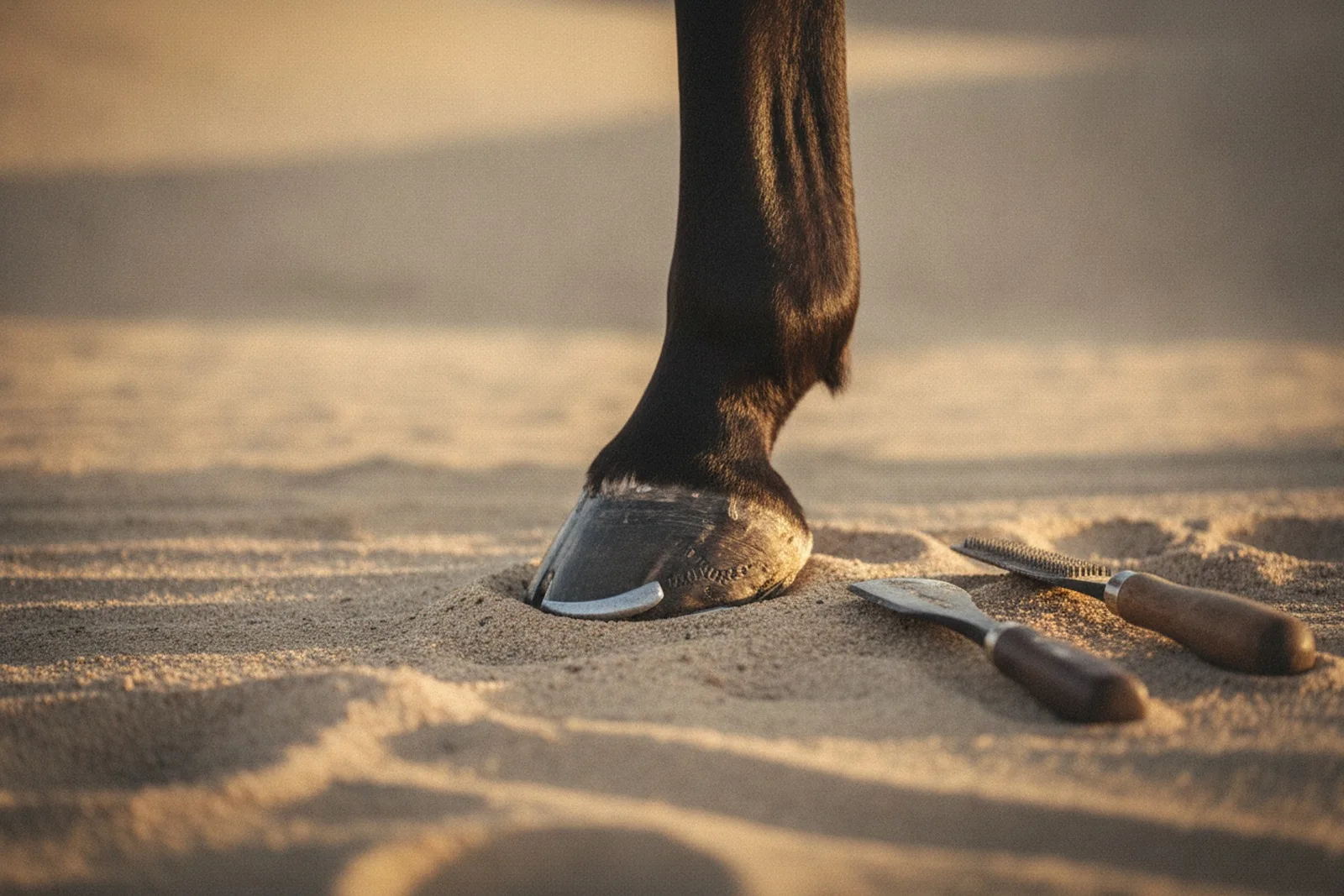
The hoof carries half a ton of live weight on the area of your palm. Everything that happens to a horse from the neck down shows up down here sooner or later.
Below: how it is built, what counts as normal, and what you are paying a farrier for every six weeks.
What the hoof is made of
From the outside you see four things: the hoof wall, the sole, the frog and the heel bulbs.
The hoof wall carries the weight. It grows down from the coronary band at 6 to 10 mm a month, about a quarter of an inch. A full replacement takes 9 to 12 months: the horn you see at ground level today grew almost a year ago.
The sole is the concave plate inside the wall. It is not a weight-bearing surface and must not be pressed on.
The frog is the wedge of soft horn at the back. It works as a shock absorber and as a pump: it spreads under load and drives blood back up the leg. A horse that does not load its frog loses circulation in the foot.
The white line is the narrow seam where wall meets sole. It is how the farrier knows where a nail can safely go. A widening white line is the first sign of trouble.
Inside sit the coffin bone, the navicular bone, the tendons and the laminae that suspend the whole structure from the wall. That is radiograph territory, not owner territory.
What the parts are called
The terms get mixed up, so, briefly.
| Part | What it is |
|---|---|
| Coronary band | the skin-to-horn junction, where growth starts |
| Toe | the front of the wall |
| Quarter | the wall between toe and heel |
| Heel and bars | the back of the wall, folded inwards |
| Sole | the concave plate inside |
| Frog | the soft wedge at the back |
| Heel bulbs | the cushions above the frog |
| White line | the seam between wall and sole |
Angles and the hoof-pastern axis
The main rule is a straight hoof-pastern axis. The line running from the fetlock down through the front of the hoof should have no break in it. When it breaks forward or back, load lands on the tendons in the wrong proportion.
Rough guides for the toe angle to the ground:
- front feet, 50 to 55 degrees;
- hind feet, 55 to 60 degrees.
Those are averages. A Spanish horse usually has a steeper foot of smaller diameter than a warmblood of the same height; a draught horse is flatter. The right angle for the horse in front of you is set by its own pastern axis, not by a table.
Trimming: interval and logic
Every six to eight weeks. Horn grows more slowly in winter and the interval stretches to eight or ten; in summer it shortens.
What happens without it: the wall runs on, the toe goes forward, the heel folds under, the axis breaks. After that come tendon overload and a change in the way the horse moves. A horse whose feet have not been touched in six months is not put right in one farrier visit.
Signs it is due: the foot looks long in the toe, the shoe overhangs at the heel, the horse trips more often.
Shoes or barefoot
An old argument with no universal answer. The answer depends on the footing and the workload.
| Situation | Usual choice |
|---|---|
| Turnout and arena, light work | barefoot |
| Roads, stone, a lot of mileage | shoes or hoof boots |
| Thin sole, poor horn quality | shoes |
| An orthopaedic problem | shoes, prescribed by the vet |
| Young horse not yet started | barefoot |
Barefoot is not "do nothing". It is the same trimming cycle without the shoes. A horse with no shoes and no trimming is not barefoot, it is neglected.
Godo PM goes without shoes. The footing in Valencia is sand, there is no road work, his horn is dense. If that changes, the decision changes.
What to check every day
Pick the feet out before and after work. While you are down there, look.
Heat. A wall noticeably warmer than the opposite foot is worth a second look.
Digital pulse. Normally you can barely feel it at the fetlock. A distinct throb is a signal. Learn where it is on a sound horse, so you have a baseline.
Smell at the frog. A sharp rotten smell and a black wet central sulcus is not dirt, it is thrush starting.
Cracks in the wall. Surface ones happen to everybody. Cracks that go through, and cracks that run down from the coronary band, are a farrier call.
Lameness on hard ground. Checked on tarmac or concrete, at walk and trot, in a straight line and on a circle both ways.
When to call the vet
I am not a vet and I will not treat feet in print. But you need to know the signs that mean you phone now:
- the horse will not put a foot down, or shifts weight foot to foot standing still;
- a hot hoof plus a strong digital pulse;
- the horse stands with its front legs pushed out in front and the hinds under the body;
- a puncture — a nail, wire, anything foreign in the sole;
- swelling at the coronary band, or discharge from under it.
Do not pull the nail out before the vet gets there. Its position tells them the depth and direction of the tract.
What this means for the owner
Trimming is the most regular cost after livery. In the United States a trim runs $50 to $80 and a set of four shoes $150 to $250; in Britain roughly £35 to £50 and £80 to £120; in Spain €30 to €60 for a trim and €80 to €150 for a full set. Figures well below those usually mean the farrier is in a hurry.
You find a good farrier the way you find a good rider: you look at the work six weeks after the visit, not on the day. If the foot still holds its shape at week six and the axis has not broken, the farrier is good.
When you buy a horse, the feet get looked at before anything else. What else to look at and how to budget for it is in how much a horse costs. I do the searching in Spain myself and I see the feet before you pay a deposit — terms here.