Thrush in horses: how to spot it and clear it
What thrush looks and smells like, where it comes from, what the owner does by hand, and where management ends and the vet's work begins.
Thrush is the commonest foot problem an owner finds without any help. It is also the commonest one the same owner lets run: it smells for weeks before the horse goes lame.
Below: how to tell thrush from ordinary muck, what gets done by hand, and the point at which the conversation moves to the vet.
What is happening to the horn
The frog is the soft wedge of horn at the back of the foot. It works as a shock absorber and a pump: it spreads under load and drives blood up the leg. I went through the whole structure separately in horse hoof anatomy.
Thrush is the breakdown of frog horn by anaerobic bacteria. The key word is anaerobic: they need somewhere with no air. A deep narrow sulcus packed with wet manure gives them exactly that, and so does a foot that stands in damp bedding around the clock.
This is not a disease that arrives from outside. It is a set of conditions. The bacteria live in every barn, and in a dry clean foot they destroy nothing.
How to spot it
The signs usually arrive in this order.
The smell. Sharp, rotten, unlike anything else. It comes first, and most people find thrush with their nose before their eyes.
Black paste. Wet, smeary, tar-like. It comes away on the pick and leaves a hollow behind it.
A deep central sulcus. Normally the cleft between the heel bulbs is shallow and open. If the pick disappears into it like a slot and the edges meet over the top, there is no air in there and the process is going deeper.
A crumbling frog. Horn peeling away in flaps, tissue that crumbles instead of cutting cleanly.
Lameness. A late sign. Usually shows on hard or stony ground, or on a turn.
| How far it has gone | What you see | Who decides |
|---|---|---|
| Early | smell, black paste in the sulci, frog still firm | owner and farrier |
| Middle | deep narrow sulci, crumbling horn, frog losing its shape | farrier, vet if in doubt |
| Advanced | bleeds when picked out, painful, lame, heat in the foot | vet only |
Blood from routine picking out is not normal at any stage. It means the breakdown has reached live tissue, and from there the vet decides.
Where it comes from
The causes are almost always mundane, and there are almost always several of them at once.
| Cause | What to do about it |
|---|---|
| Wet bedding, skipped out rarely | muck out more often, look at the stall drainage |
| The horse barely moves | more turnout; the frog only works under load |
| Feet not picked out daily | the cheapest prevention there is |
| Contracted heels, a narrow deep sulcus | hoof shape is a farrier's job, not an ointment's |
| A long trimming interval | get back onto a normal cycle |
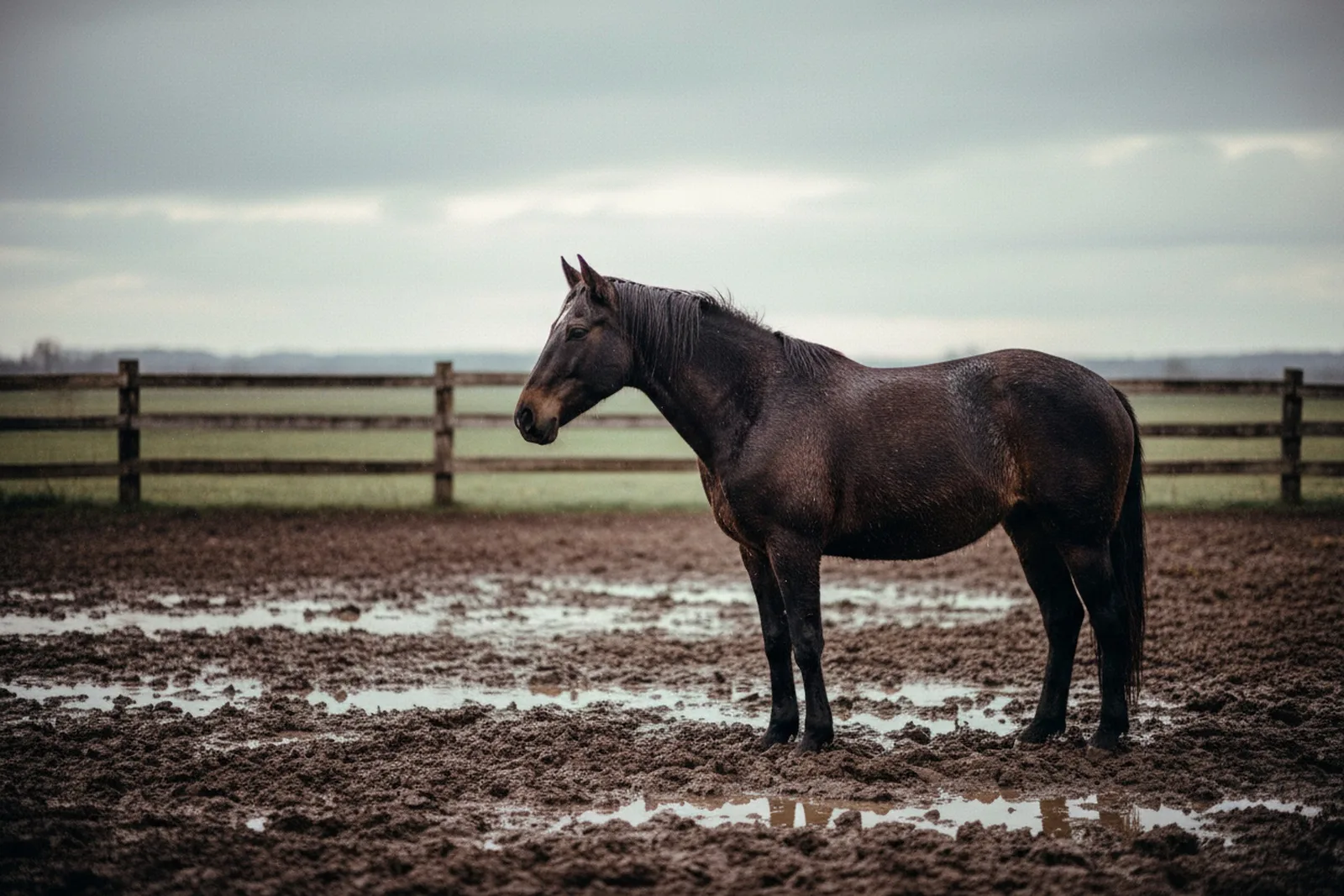
| A wet, poached winter paddock | somewhere dry to stand |
On the interval and the logic behind it — hoof trimming.
What the owner does
Three things, and they matter more than any product on the shelf.
Dry. The foot has to spend more time dry than wet. If the stall is wet, nothing you put on the frog will work.
Clean. A pick every day, before and after work, through both collateral sulci and the central one. Not a tap on the sole — cleaned out.
Movement. The frog cleans itself when the horse works. A horse that stands loses both the shock absorption and the circulation at the back of the foot.
Then trimming. The farrier cuts away the undermined horn and opens the sulci so air gets in. Until the loose horn is off, there is nothing to treat. That is their job, not yours: it is easy to cut live tissue out from under a dead flap.
About treatment, plainly
I am a horse owner, not a vet. I do not write protocols or concentrations — those come from the vet, or from the farrier who has the foot in their hands.
What is worth knowing before you talk to either of them: anything strong enough to burn rotten horn burns healthy horn just as well. Strong solutions poured in generously and just in case dry the frog out and leave it brittle. After that it falls apart with no bacteria involved at all.
So the question for the vet is not "what do I pour on it" but "what is going on with the shape of this foot, and why has the sulcus closed over".
When it is not thrush any more
Several things look similar and are handled differently.
- Hoof abscess. Sudden lameness, often to the point of not bearing weight, heat in the foot, a strong digital pulse. Urgent.
- Pastern dermatitis — mud fever, scratches. Skin at the pastern, not horn. A separate subject.
- Laminitis. The horse stands with its front legs out in front, shifts about, will not move. Nothing to do with thrush — laminitis.
- Deep frog infection. Thrush that has reached sensitive tissue. From outside it looks like the ordinary kind, but the horse flinches at a touch.
The general rule: lameness, heat and a digital pulse move any foot problem out of management and into a vet call.
What I do
Godo PM goes barefoot, and the footing in Valencia is sand and dry. Half of my prevention is done by the climate, and I will say so plainly: the same horse in a wet northern winter would need a completely different stall routine.
The other half is a pick every day and trimming on time. I have nothing cleverer than that.
When I am looking at a horse for a buyer, I check the feet before the deposit and I smell the frog before I watch it move — because a neglected frog costs the new owner months of work and money. Terms are on the services page.