Western riding and reining: sport out of cattle work
Where the western disciplines came from, what a reining horse does, how trail, cutting and pleasure differ, and what tack and breeds the style takes.
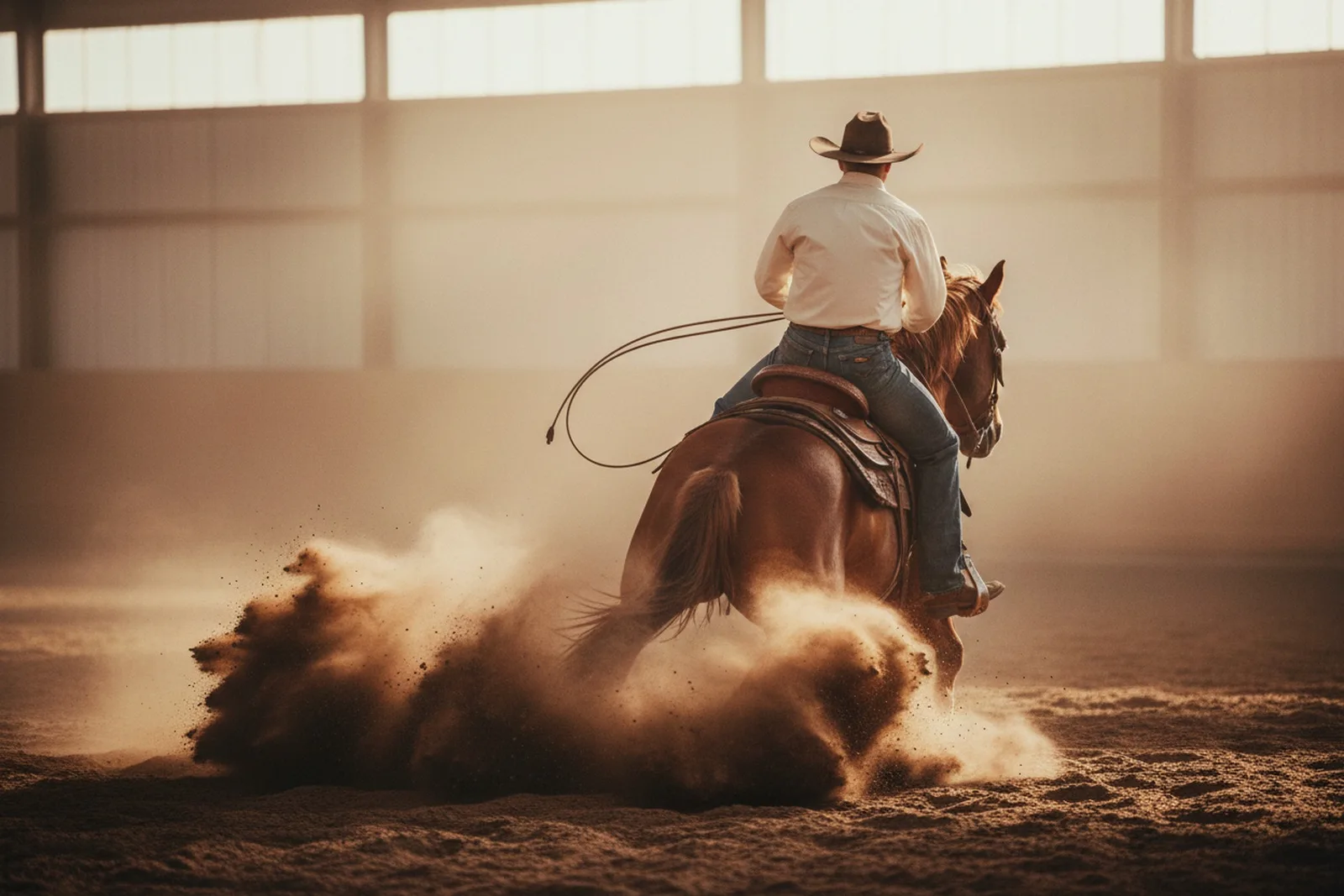
Western riding is not a costume version of a film. It is a sport assembled out of a working cowboy's technique: a horse under a stockman had to turn on the spot, come out of a lope to a stop, and hold a cow while the man was busy with a rope. Every figure judged in an arena today was once a requirement of the job.
I do not ride western and I do not prepare horses for it. I write as an owner interested in the logic: how a work task turns into a discipline.
Reining
The best known of the western disciplines and the only one that reached international level. The horse rides a pattern from the rider's memory: a set of figures in a fixed order, at the lope, on an almost loose rein.
The sliding stop. From the lope the horse brings his hind end under the body and slides on his hind feet through the ground while the front feet keep walking. It takes purpose-made sliding plates and correctly prepared footing — deep and loose on top, firm underneath.
The spin. A turn on the spot around a hind leg. The inside hind stays planted, the other three go around it. Judges look at speed, evenness, and at whether the horse moved the pivot foot.
The circles. Large fast and small slow, with a change between them and no change of gait. That is not decoration in the pattern, it is the proof that the horse is ridden by the tempo rather than by the rein.
The rollback. A stop, a 180-degree turn over the hocks, and straight back into the lope the other way with no pause.
Flying changes. In the middle of the arena, in the air, with no break in the rhythm.
How it is judged
Under NRHA rules the scoring starts from a notional average of 70. For each manoeuvre a judge adds or subtracts up to one and a half points in half-point steps, and the total is built from there. Penalties are taken off separately: breaking gait, over- or under-spinning, going outside the pattern.
What is scored is not spectacle but willingness. A horse who performs a figure himself, off a barely visible signal, scores above the same figure squeezed out with rein and spur.
The other disciplines in short
- Trail. An obstacle course built from working situations: poles, a bridge, a gate to be opened and closed from the saddle, backing through a corridor. Accuracy and calm are judged.
- Cutting. The horse separates a cow from the herd and does not let her back. Once the work has begun the rider drops his hand — from there the horse works alone. The most direct descendant of the ranch.
- Western pleasure. Travelling on a circle in three gaits, judged on evenness, relaxation and how comfortable the horse is to sit on. The discipline that draws the most argument: the chase for a slow gait has damaged the movement of a lot of horses.
- Barrel racing. Three barrels, a cloverleaf pattern, a result against the clock. Pure speed and the work in the turns.
Tack
The saddle. A western saddle is heavy, with a wide tree, a large bearing surface and a horn at the front. The horn is not a handle for the rider, it is where the rope is dallied when working stock. The wide bearing surface spreads the weight over the back, which is exactly why you can spend a day in it. Fitting a saddle to a back is in how to fit a saddle.
The bit. A snaffle on a young horse, a leverage bit on a finished one. In western work a curb is not a brake, it is a channel for a signal: the rein hangs in a loop and the horse answers the change in that loop before he answers any pull.
The draped rein. The signature of the style. A finished western horse travels on a slack rein, in one hand, and is steered by weight, leg and the rein laid against the side of the neck.
The seat. A long stirrup, a nearly straight leg, an upright body, the second hand free. It is free because it used to hold a rope.
The horses
- Quarter Horse. The number one breed. Powerful hindquarters, a low centre of gravity, speed over a short distance, an inborn interest in cattle.
- Paint. The same type, a separate registry based on coat pattern.
- Appaloosa. The spotted breed from the American Northwest, widely represented in western sport.
What all three share is a strong short body, a powerful loin and the ability to drop abruptly onto the hindquarters. That build is for starting, stopping and turning, not for covering distance.
Reining and doma vaquera: one job, two answers
The parallel is the thing I find most interesting in either discipline.
Both grew out of exactly the same situation — a man on horseback working livestock all day. Hence the shared list of requirements: rein in one hand, the second hand free, an abrupt stop, a turn over the hocks, movement off a minimal signal.
| Reining | Doma vaquera | |
|---|---|---|
| Origin | North American ranches | the pastures of Andalusia |
| Stock | cattle | fighting bulls |
| Horse | Quarter Horse, Paint | PRE, Lusitano |
| Saddle | western, with a horn | vaquera, high pommel and cantle |
| The stop | a slide through the ground | abrupt, hind end under the body |
| The test | a set sequence of figures | a set sequence of figures |
What differs is the type of horse and the character of the movement. The Quarter Horse was selected for a low flat stride and a burst of speed, the Iberian horse for a high collected step and work upward. A bull is more dangerous than a cow, and the vaquera horse had to move away from the horn rather than hold the animal with his body.
The Spanish half of the pair is in doma vaquera.
What I do
I do not source western horses. The Quarter Horse market is American and German, with its own expertise, and I do not work in it.
I find Iberian horses in Spain and Germany — for dressage, vaquera, breeding and photography: terms here.