Mare pregnancy and foaling
Confirming pregnancy by scan, twins and reduction, feeding and work by trimester, the signs before foaling, the three stages of labour and the 1–2-3 rule.
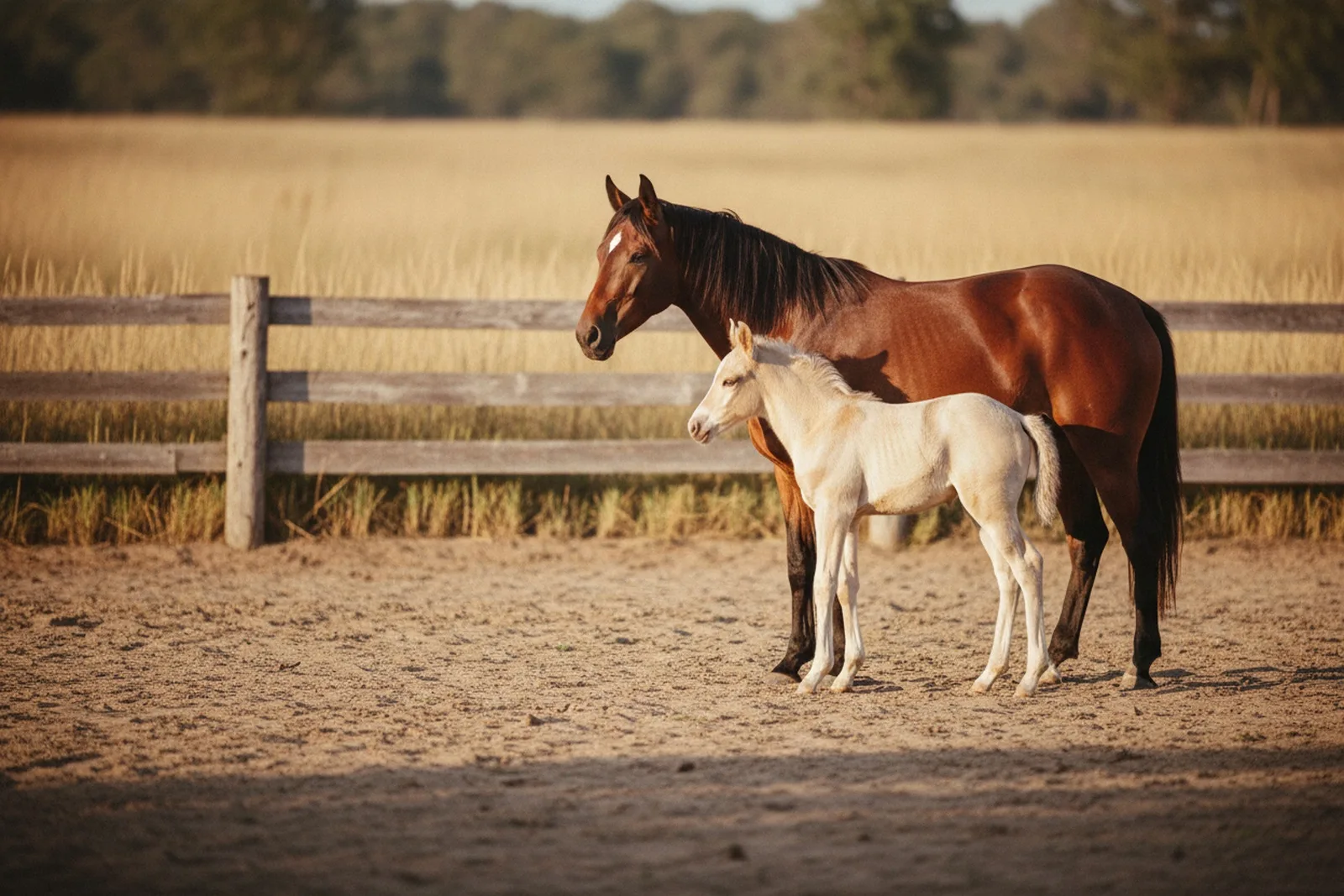
Pregnancy in the mare runs 320 to 360 days, averaging around 335 to 340. Maiden mares and winter foalings often go past the upper end. Eleven months is a convenient round number, not a rule.
One thing up front: I am a horse owner, not a vet. Everything below is the sequence you need to know in order to call the vet at the right moment and understand what he tells you. Decisions about a particular mare are his.
How pregnancy is confirmed
There is no point waiting for external signs. Until the seventh month the mare looks the same as always. Confirmation is by transrectal ultrasound, on a schedule.
| Stage | What is checked |
|---|---|
| Day 14–16 | first scan, the vesicle, twin check, always |
| Day 25–28 | foetal heartbeat |
| Day 40–45 | reconfirmation, early loss |
| From 60 days | sex can be determined |
| Months 5, 7, 9 | vaccination against equine herpesvirus |
Early loss is common, and that is exactly why the scan is repeated. A mare confirmed on day sixteen can be empty on day forty-five. Better to find that out in April than in March of the following year.
Twins, and why one is removed
A twin pregnancy in a horse is not luck, it is a complication. The mare's placenta is not built for two: there is not enough uterine wall for both, and nutrition is not divided in half but however it falls.
The typical outcome without intervention is abortion at eight or nine months and the loss of both foals, often along with the mare's future fertility. A handful are born alive, usually premature.
So one vesicle is reduced at 14 to 16 days. At that stage it is still mobile, the procedure is done per rectum without surgery, and the remaining foal develops normally. A month later it is a different conversation with different risks.
A skipped first scan is the most expensive economy in breeding. How the insemination and ovulation control work up to that point is in the article on breeding.
Feeding by trimester
For eight of the eleven months the foal grows slowly. Most of the mass is put on in the last third.
First and second trimester. The ration does not change. The mare needs a normal body condition, good forage and a mineral balancer, and that is all. A mare overfed in early pregnancy gets joint problems and a hard foaling, not a bigger foal.
Third trimester, from month eight. Requirements rise for energy, protein, calcium, phosphorus, copper and selenium. Concentrates go in gradually, with smaller meals more often: the uterus is pressing on the stomach and gut. Free access to water all year round, winter included, is not optional.
Last month. Feed more often and in smaller amounts. No abrupt changes of feed at all.
Work
A pregnant mare gets worked. A mare standing in a stall means oedema, excess weight and a difficult foaling.
- To month 7 or 8 — normal routine unless the vet says otherwise. Jumping and competition come off earlier, on common sense.
- Months 8 to 10 — walk, light trot, turnout. No sharp work, no slippery ground.
- Last month — free movement in the paddock and led walks. That is enough.
Signs that foaling is close
Nobody has an exact date. There is a sequence, and it unfolds over several weeks.
- 3 to 6 weeks out the udder starts to fill, more by evening, less by morning.
- 1 to 2 weeks out the ligaments over the croup relax, the croup drops, the vulva lengthens.
- 1 to 3 days out the udder stays full and no longer goes down overnight.
- 12 to 48 hours out wax appears on the teats — dried beads of colostrum.
- Hours out colostrum runs on its own, the mare is restless, gets up and down, looks at her flank, sweats behind the shoulders, takes herself to a corner of the box.
Waxing is the most reliable of the early markers, and it still lies: some mares foal without it. Calcium test strips for milk narrow the window to a day or two.
By this point the box should be large, deeply bedded in straw, with no corner a foal can wedge itself into. The vet's number goes in your hand, not in an address book.
How foaling goes
Three stages. Speed is what separates the horse from other species: in the mare everything happens very fast.
Stage one, 1 to 4 hours. Contractions, restlessness, sweating. It ends when the waters break. Leave the mare alone through this: she can stop the process if disturbed.
Stage two, 15 to 30 minutes. Delivery. The foal comes in a diving position: two feet first, soles down, one slightly ahead of the other, then the nose lying on the knees. Thirty minutes with no progress means calling immediately.
Stage three, up to 3 hours. The placenta is passed. Keep it and show it to the vet whole: it tells you whether all of it came away.
Call the vet at once, without waiting for anything, in four cases:
- Stage two runs beyond half an hour with no progress.
- A thick red velvety sac appears at the vulva instead of the white bag. That is premature placental separation, and the foal is suffocating.
- The presentation is wrong: one leg, a head with no legs, soles pointing up.
- The placenta has not come away in 3 hours.
The foal's first hours
There is a simple rule for checking that things are normal — 1–2-3.
- 1 hour — the foal is standing.
- 2 hours — it has nursed and taken colostrum.
- 3 hours — the mare has passed the placenta.
Any point missed is a reason to phone, not to wait. Colostrum only works in the first hours: the newborn gut absorbs antibodies for roughly 12 to 24 hours, and then the window closes. At 18 to 24 hours blood is drawn for IgG to check whether the transfer of immunity worked. In the US that test is routine on any well-run breeding farm, and it is worth insisting on.
Meconium — the first faeces — should pass within the first day. If it has not and the foal is straining with its tail clamped, that is a call to the vet, not a job for home remedies.
From me
I do not attend foalings and I do not give veterinary instructions. My part starts earlier and continues later: choosing the match, genetics, semen, and then what to do with the horse that grows out of it.
Godo PM — PRE born 2022, bay double pearl, LG PRE ANCCE. He has no offspring yet: this is his first breeding season. Semen terms and the colour grid are on the breeding page.
If you are reading this because you are thinking of buying a foal rather than breeding one, that is covered separately — age, weaning, and what to look at.