Rider position: what actually makes it correct
What a rider's position is made of, where the ear-shoulder-hip-heel line runs, how a chair seat differs from a fork seat and how to check yourself on video.
Position usually gets explained as a pose: back straighter, heel lower, hands softer. That is how it gets learned, too — as a set of placements that falls apart at the first transition.
Position is not a pose. It is a way of keeping balance on a moving animal. Everything else follows from that.
The line everything starts from
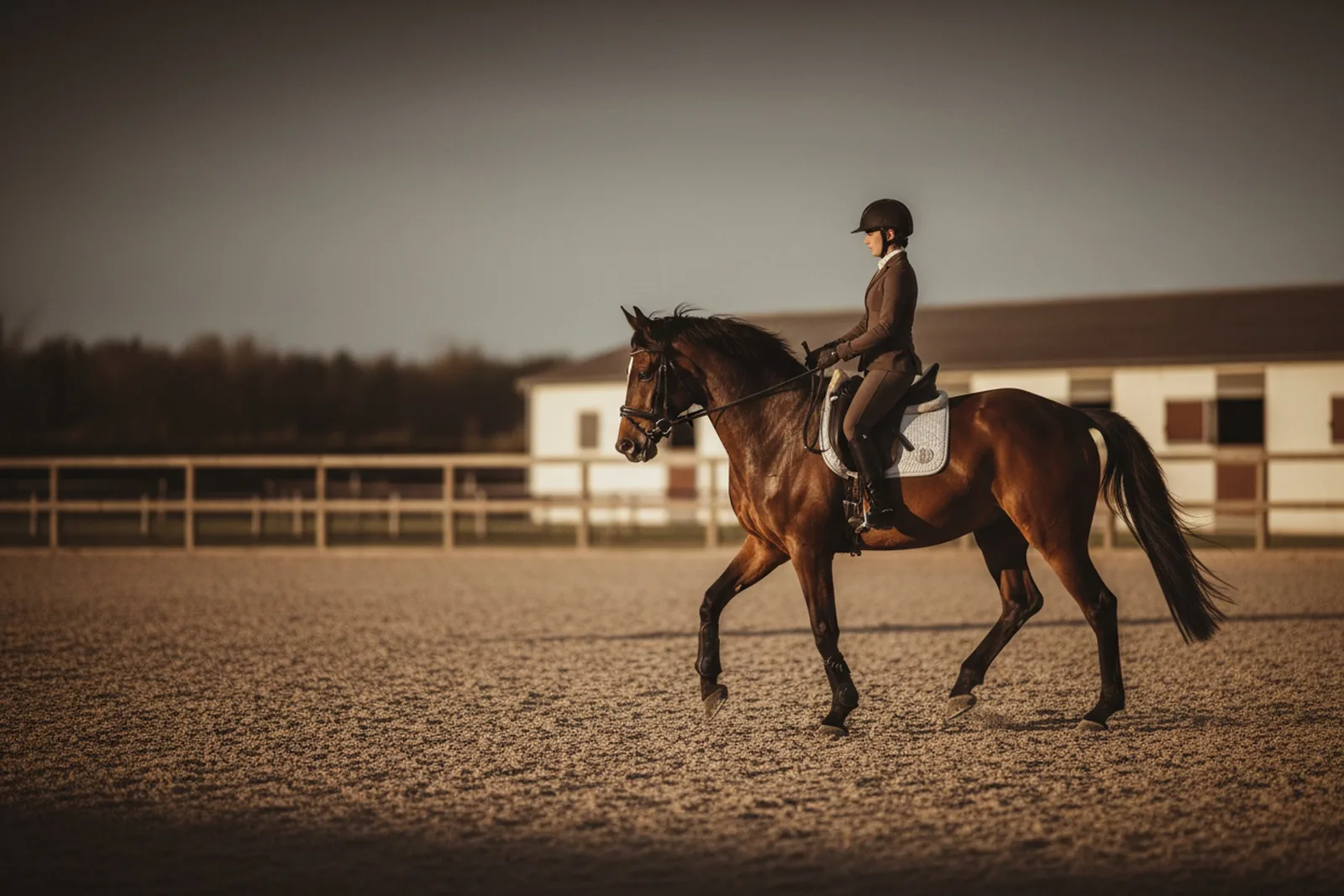
There is one basic reference: ear, shoulder, hip and heel stand on a single vertical line. The second line runs from the elbow through the forearm and the rein to the horse's mouth.
The point of the first line is that the rider is held up by his own skeleton rather than by muscle. A position like that does not tire and does not get in the horse's way: the weight goes down, not back and not forward.
The point of the second is that the hand is joined to the horse directly, with no break at the wrist and no loop in the rein. Anything that bends along that line turns a signal into noise.
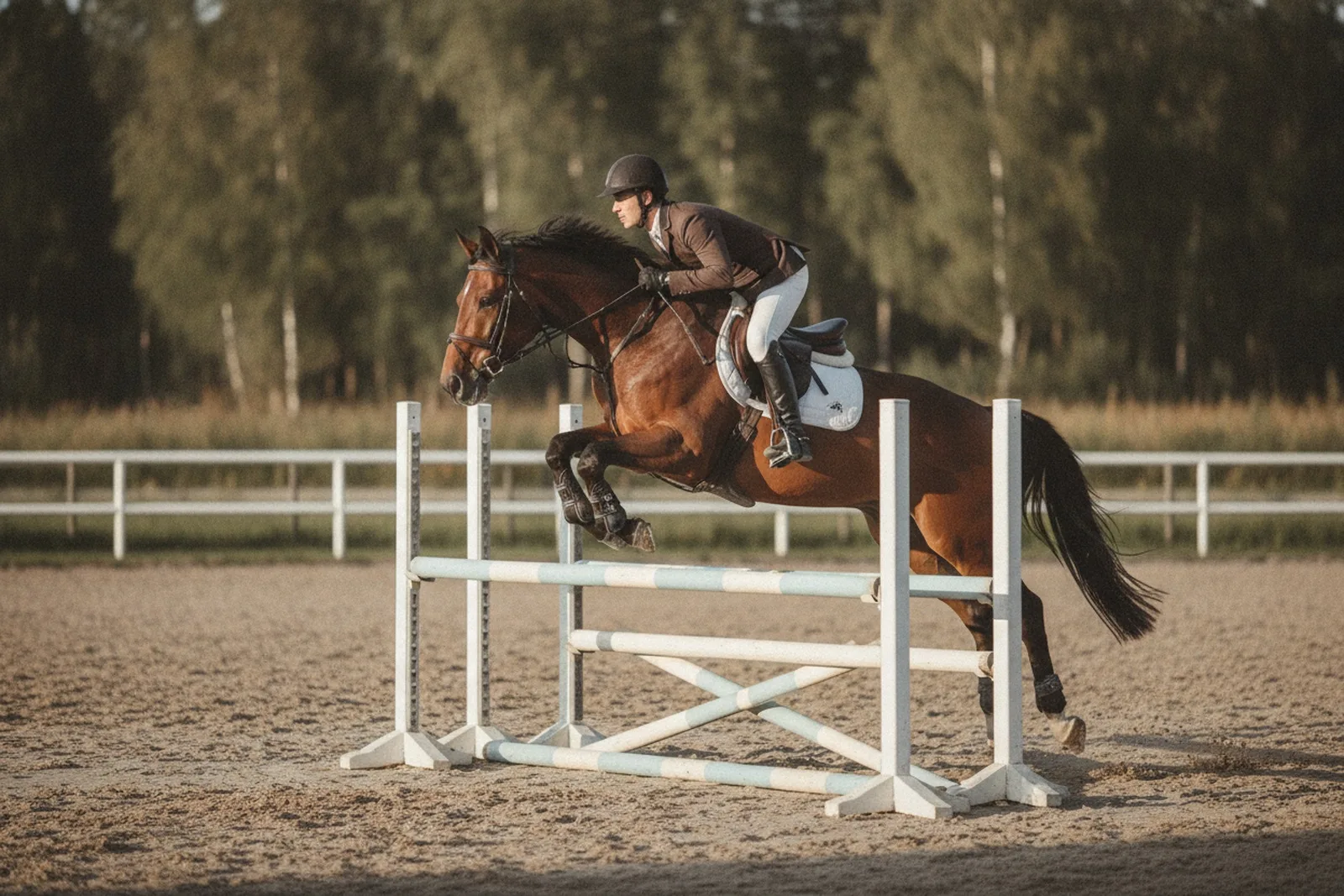
Both lines are references for flatwork. In a forward seat and over a fence the vertical is broken deliberately, with a shorter stirrup and the upper body out over the horse.
The pelvis decides more than the back does
What a rider actually sits on is two seat bones and the pubic bone. A triangle whose angle changes everything above it.
| Position of the pelvis | What the horse feels | When it is a fault |
|---|---|---|
| Neutral, weight on both seat bones | even contact with the back, movement free | almost never |
| Tipped back, weight on the buttocks | pressure into the back of the saddle, a locked lower back | the chair seat, and the commonest of all |
| Tipped forward, weight on the pubic bone | the saddle driven forward, the horse falling onto the forehand | when the back is "straightened" by force |
A straight back is a consequence of a neutral pelvis, not an exercise of its own. A rider who straightens his back by hollowing his lumbar spine gets a rigid torso and loses the ability to follow the movement.
Easy to test: if your lower back does not give at the walk, the pelvis is wrong.
The leg
The rider's leg comes in three parts and each has its own job.
The thigh hangs down and turns in without being forced. A gripping knee pushes the rider up out of the saddle. It is support in the wrong place.
The lower leg lies against the horse's side softly and constantly. Constant contact is not constant pressure. A leg that pushes all the time stops meaning anything.
The heel sits lower than the toe not because it looks well, but because it is what happens when the weight of a relaxed leg is allowed down. You do not press the heel down, you let it go. A heel that comes up nearly always travels with a gripping knee.
On length: a stirrup too long has you reaching with the toe, a stirrup too short pushes the knee forward. Both faults show up in the vertical line before they show up in the feel.
Five common faults
| Fault | What it looks like | What is usually behind it |
|---|---|---|
| Chair seat | knees forward, pelvis back, the rider sitting in an armchair | a long stirrup, or a fear of tipping forward |
| Fork seat | pelvis forward, legs behind, the upper body tipped | trying to hold on with the knee |
| Heel up | toe down, lower leg sliding back | a gripping knee, a short stirrup |
| Busy hands | wrists moving up and down, the rein tight then slack | the hands keeping balance instead of the body |
| Eyes down | head dropped towards the withers | the habit of watching the horse to control it |
The last one costs more than it looks. A head weighs enough that tipping it changes the balance of the whole arrangement.
What changes from gait to gait
The position is not identical everywhere. What changes is the way of following the movement.
At walk the pelvis travels forward and back with the horse's back and the lower spine stays soft. It is the best gait for taking your own position apart.
At trot there is a choice. Sitting trot needs a loose lower back and a torso that works independently of it. Rising trot — posting, in the United States — is lifted by the horse's movement rather than pushed out of the stirrup. A rider who stands up on his own is always late.
At canter the pelvis follows an arc, the upper body stays vertical, and the hands go with the neck.
What gets in the way from outside
Half of these problems are not about the rider.
The saddle. One that fits neither the rider nor the horse's back puts the pelvis wrong on its own. Too deep sits you back, too flat gives you nothing to sit on. How they are fitted is here.
The horse's back. A sore back makes a horse move stiffly, and the rider gets knocked out of balance at every step.
The horse's level of training. Nobody has a lovely position on a horse that cannot hold a rhythm.
The rider's own body. Different leg lengths, an old injury, a stiff hip. None of that is fixed by being told to sit up straight.
How to check yourself
Three methods, none of which needs a trainer standing in the frame.
Video from the side. One camera, walk and trot, then freeze a frame: the vertical shows up at once. A mirror in the arena gives you the same thing, but only while you are looking at it, and looking at it has already distorted the position.
Work on the lunge with no stirrups and no reins. The fastest way to find your own balance, because there is nothing left to hold on with. The tool itself is in lungeing a horse. In a helmet, always.
A check at the halt. Stop, take your feet out of the stirrups, let the legs hang and look at where they end up. If the stirrup is in front of your foot, the position is sliding backwards.
What I do
I do not coach and I do not put positions on people. I write as an owner who rides herself and who watches other people's positions from the ground while her stallion is being worked.
What I see from down there most often: a rider fighting his own balance and explaining it by the horse's temperament. Godo PM answers a shift of weight before he answers the rein, and that is probably the most honest position coach available.