Lungeing a horse: what it is for and how to do it
What lungeing is actually for, the kit you need, how big the circle should be, where to stand, how to hold the line safely and the mistakes people repeat.
A lunge line is not a way to take the edge off before you ride. It gets used that way constantly, and that is precisely why most horses read the lunge as pointless circling until they are tired.
Lungeing — longeing, if you write in American English — is gymnastic work from the ground where you see the whole horse at once: how it carries itself, where the quarters drift, where it falls in on the circle, whether it goes the same on both reins. From the saddle you never see any of that.
What it is for
Five jobs, each of them complete on its own.
- Starting a young horse. It learns to go forward from the voice and from the whip, to listen to a person and to hold a rhythm, before anyone sits on it.
- Gymnastics. Balance, carriage and stretch without the rider's weight. Particularly useful to a horse with a weak back.
- Diagnosis. A circle shows up lameness that a straight line hides, because the inside limb takes more load. More on that in lameness and tendon injuries.
- Rehabilitation. Measured movement after an injury or after a long spell in, when riding is still too early.
- Reading the mood. Five minutes on the lunge tell you what state the horse is in. Sometimes that is enough to decide not to ride at all today.
None of those five is solved by chasing a horse round a circle. Chasing solves a sixth job I do not put on the list: wearing the horse out. It works, and the joints pay for it.
The kit
| Item | Why |
|---|---|
| Lunge line, 8–10 m (26–33 ft) | the length sets the size of the circle |
| Lunge whip with a long lash | an extension of your arm, not a punishment |
| Lunge cavesson | a ring on the nose, the point the line clips to |
| Brushing boots or bandages, all four legs | protection against strikes on a circle |
| Gloves | a lunge line takes the skin off in a second |
The cavesson is the correct attachment. A line clipped to the inside bit ring drags the mouthpiece across the tongue and spoils the mouth; a line clipped to an ordinary headcollar gives you no accuracy of flexion at all.
If you have no cavesson, the next most reasonable option is the line passed through the inside bit ring, over the poll and clipped to the outside ring. The pressure spreads instead of pulling the jaw sideways.
The circle
Diameter is the single number that governs the whole session.
Under 15 m (50 ft) the horse is in permanent bend, the load sits on the inside joints, and the younger the horse the worse that is. At 18 to 20 m (60 to 65 ft) it can move in balance. The rule of thumb is simple: the smaller the circle, the shorter the session and the slower the pace.
The footing has to be level and not deep. Deep sand on the lunge loads tendons directly, because the foot slides sideways at every step.
Work on one track. A circle that shifts every stride empties the exercise of meaning: the horse never finds its balance, because the geometry keeps changing.
Where you stand
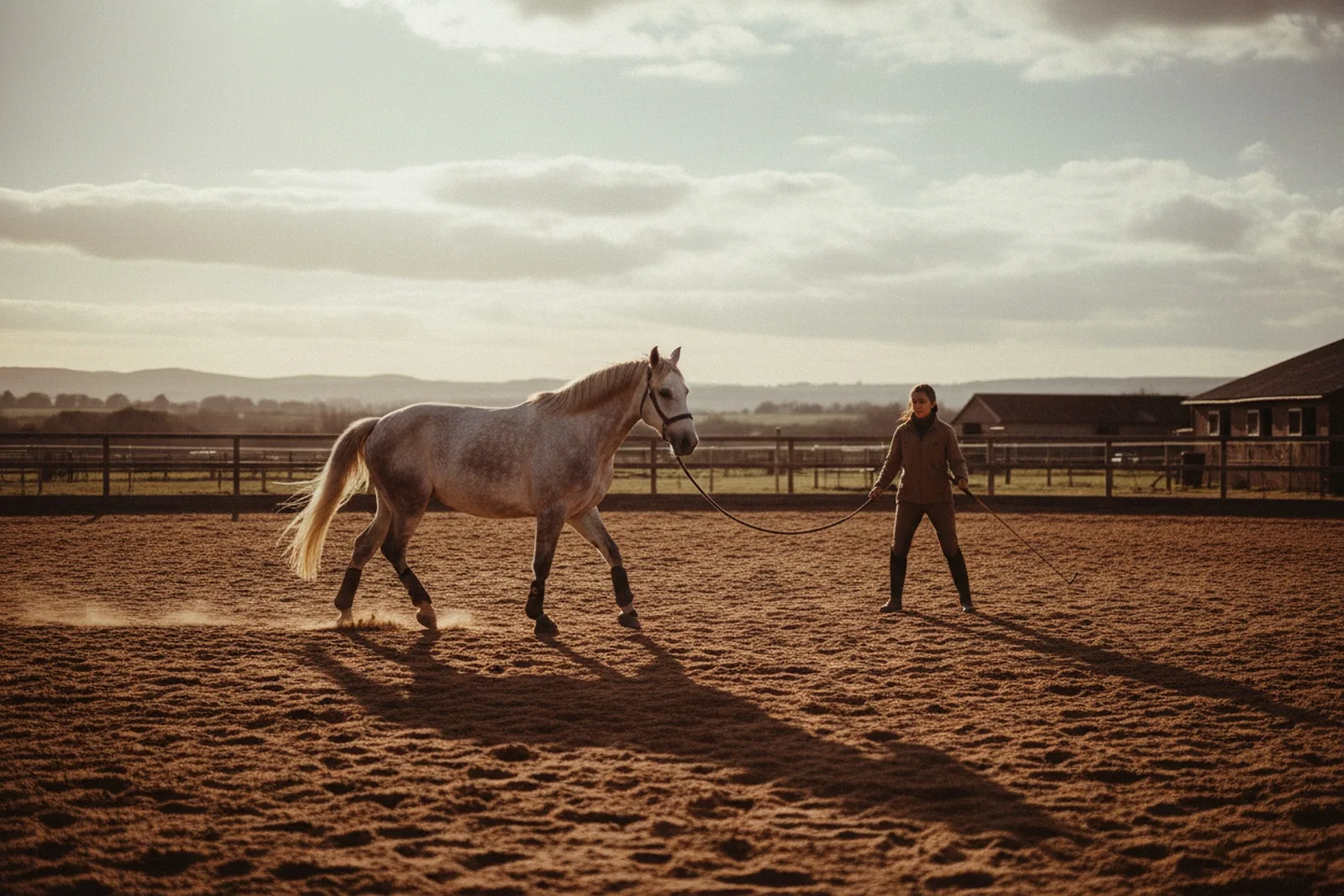
Person, horse and whip make a triangle. The line goes to the head, the whip points at the quarters, and your body stays level with the girth or a little behind it.
- Move forward, towards the shoulder — the horse slows or turns in.
- Move back, towards the hindquarters — the horse goes on.
- Stay level with the middle of the barrel — the horse holds the rhythm.
That is a working tool rather than a hard rule. Governing the tempo with your own position is far more precise than voice and a crack of the whip.
You move on a small circle of your own instead of spinning on the spot. Standing on one point and rotating is the quick route to dizziness and to losing the line.
Holding the line
This is the safety paragraph, and it is the only one where I leave no options.
The line never goes round your hand, your wrist or your fingers, not one turn. Half a tonne of horse that startles and takes off will remove fingers. The spare end is folded in loops and held in the palm so that it can leave the palm.
The rest:
- gloves every time, even for five minutes;
- the line never trails on the ground in a loop a leg can find;
- the whip is not dropped inside the circle;
- in canter you stand a touch wider, so you are not gathering line in snatches.
How long and how often
A proper lunge session is 15 to 25 minutes including the walk. That is not "only": a circle loads more than a straight line, and an hour on the lunge is harder than an hour ridden.
You change the rein, and roughly evenly. Nearly every horse has a worse side. It gets a little more attention, not twice the time.
The order inside a session is the usual one: walk on a long line, trot, short canter sets, trot again, walk. Canter on a small circle is the hardest thing you can ask for, and on a young horse it comes in doses of a few circles.
Side reins, chambon, de Gogue
Training aids that put the head and neck in a set position. This is where opinion divides in earnest.
| Aid | What it does | The complaint against it |
|---|---|---|
| Side reins | fix the head between two straps | the horse leans on them instead of reaching |
| Chambon | acts on poll and mouth if the head comes up | very easy to over-tighten |
| De Gogue | links poll and mouth, lowering the neck | strong leverage in inexperienced hands |
All three have one thing in common: they produce a head position, not a working back. A horse can drop its nose and still travel with a hollow back and trailing quarters — which is exactly what you brought it out to fix.
My own order: first the horse learns to go forward, straight and in rhythm, with nothing on it. Aids are a question for the second year, not the first session.
Common mistakes
- Too short a line. An eight-metre circle instead of an eighteen-metre one.
- Constant tension. The line should carry a slight loop; a line that pulls teaches the horse to pull back.
- Working on one rein only. Asymmetry sets in within weeks.
- The whip as punishment. It indicates direction, it does not strike.
- Cantering round until the horse sweats. The commonest version and the most damaging.
- The lunge as a warm-up at a show. An understandable habit, but the horse goes into the ring already tired.
What the lunge does in my work
I keep one stallion and I work him myself. The lunge does two things for me.
The first is assessment. Before a purchase I always ask to see the horse lunged on both reins. You see the movement, you see the symmetry, you see how it reacts to a person without saddle or rider, and you see how it was started. It belongs to the same examination as the pre-purchase exam.
The second is work. A change of load, gymnastics without weight, the habit of listening to a voice. Add poles on the circle and it becomes an exercise in its own right.
I do not work as a trainer and I do not take on teaching a horse to lunge. What I do professionally is finding and buying horses in Spain and Germany: terms here.