Pre-purchase exam: what a PPE covers and what it costs
The five-stage vetting, the radiograph set, scope and bloods, how the German Ankaufsuntersuchung differs, who pays, and what to do with findings in the report.
A pre-purchase exam does not answer the question "is this horse healthy". It answers a different one: what does it have today, and how does that sit against the job you are buying it for. Those are two questions, and confusing them wrecks more deals than the findings do.
Below: what a PPE is made of, what gets radiographed, how the American and the German versions differ, and what to do with a report that has something in it.
Who chooses the vet
I start here because this is where people lose money, not on the exam itself.
The vet is yours. Not the one who "looks after this yard" and not the one the seller suggested. The seller's vet has no bad intent. He has a ten-year relationship with that barn and an obvious interest in the sale closing. That is enough to soften the wording in a report.
The buyer pays, and that is right: you are paying for an independent opinion. The seller owes you the horse and the facilities — a box, hard level ground and a soft surface to trot on.
Refusing to let your vet in ends the conversation. Not a negotiation, not grounds for a discount. It ends it.
The five-stage exam
Both the United States and Britain run the same five stages, and any American vet will recognise the shorthand.
- Examination at rest. Temperature, pulse, respiration, mucous membranes. Heart and lungs on both sides. Eyes with an ophthalmoscope in a darkened box — lens opacities, the aftermath of uveitis, corneal scars. Teeth with a gag: bite, sharp edges, hooks, wolf teeth, and the age checked against the papers. Skin, scars, old surgical sites, firing marks. Palpation of back, neck and withers, hoof testers on every foot. Teeth in detail: horse teeth.
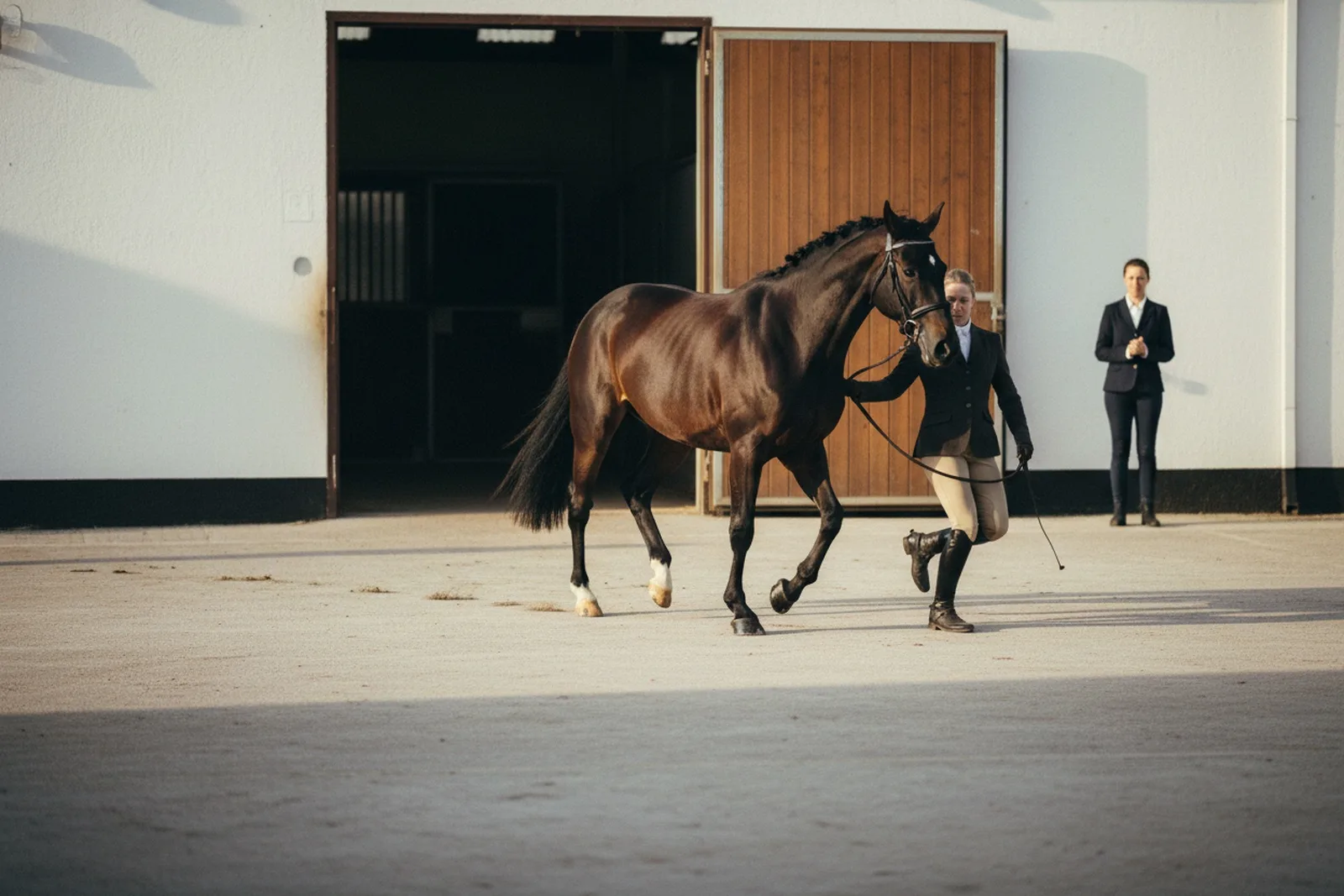
- Walk and trot in hand. Straight line on hard level ground, out and back. Turns in both directions, backing up. Then flexion tests: the vet holds a joint flexed for around a minute and the horse trots off immediately. Fetlock, hock, stifle, sometimes carpus.
- Strenuous exercise. Ridden if the horse is broken, on the lunge if not, hard enough to lift the heart and respiratory rate. The seller rides first, then you. A murmur that was quiet at rest becomes interesting here.
- Rest period. Twenty to thirty minutes while heart and lungs come back down. This stage gets skipped only to save an hour.
- The second trot up. On hard ground again. Stiffness a warm horse was hiding shows here, and this is the stage that catches what stage two missed.
A flexion test is a provocation, not a diagnosis. A positive flexion is an indication to radiograph that joint, and that is exactly how it should be read.
Radiographs
There is no universal set. The number of views is agreed in advance against the price of the horse, its intended job and its age. In the United States a "full set" for a sport prospect usually means 18 to 36 views. A typical working list:
| Area | What is being looked at |
|---|---|
| Feet, lateral and oblique | pedal bone, rotation, the navicular apparatus |
| Fetlocks | osteophytes, chips, cysts, sesamoids |
| Hocks | bone spavin, joint space narrowing, new bone |
| Stifles | OCD lesions, subchondral cysts |
| Neck and back | kissing spines, facet arthrosis |
After that it is by indication: a young sport horse gets stifles and hocks as a matter of course, a horse that flexed positive gets what the flexion lit up. The mechanics behind the findings are in lameness and tendon injuries and navicular syndrome. Ultrasound of tendons is not standard, but it is ordered for any thickening or old injury.
How the German version differs
Buy in Germany and you buy under a different system, so learn the vocabulary.
The Ankaufsuntersuchung comes in two sizes. The kleine AKU is the clinical exam without imaging. The große AKU adds the standard radiograph set, and that is the one anybody buying a sport horse orders.
The difference that matters is what happens to the images afterwards. German radiographs are graded against the Röntgenleitfaden, the national guideline, into classes: class I is a clean image, class II carries findings that are very unlikely to become clinical, class III findings that may, class IV findings that probably will. The scale in use before 2007 ran to class V, and older reports, older insurers and some sellers still quote it — so check which edition your report is written against before you argue about a number.
The American report gives description and opinion and leaves the grading to you. The German one hands you a number, which is convenient and slightly dangerous: a class is a statistical statement about a picture, not about your horse's job.
Scope, gastroscope and bloods
Upper airway endoscopy is not for everybody. Indications: any noise on inspiration, a cough, a horse going into sport or heavy work, an adult stallion. The scope looks for laryngeal hemiplegia (roaring), dorsal displacement of the soft palate, and the guttural pouches.
Gastroscopy when ulcers are suspected: poor condition on good feed, tightness under saddle, fussiness with food.
Bloods. CBC and chemistry as a baseline. Separately and always: bank the serum for six to twelve months. If the horse turns out to be a different animal two weeks after it arrives, that serum goes off for sedative and analgesic screening. It is the only defence against a horse shown to you medicated, and it costs 30–60 $.
If the horse leaves Spain afterwards, export testing has its own list and its own deadlines: importing a horse into the EU.
What it costs
A basic clinical PPE with flexions runs 300–700 $ in the United States and 250–500 € in Spain. Add a full radiograph set and you are at 1,000–2,500 $, or 800–1,800 € for a große AKU. Scope, gastroscope and ultrasound push a top-end sport horse vetting to 3,000–4,000 $. Against a 15,000 € horse and three years of board, that is the cheapest information you will ever buy about this animal.
What to do with the findings
A report is almost never empty. A horse over five with nothing on it is a rarity, not the standard.
A finding has to be read against the job. The same change reads three different ways:
- Moderate spavin in an eleven-year-old gelding for trail riding and a bit of arena work: a working situation that comes with a shoeing and workload plan.
- The same spavin in a five-year-old bought for serious sport: stop.
- Kissing spines with no clinical signs in a horse for light work: watch it. The same picture plus soreness under saddle: no.
Three questions to ask out loud, and get answered in words rather than a nod:
- What here is a problem today?
- What here will most likely progress over three to five years under my workload?
- What will it cost me to keep this horse with this finding?
A PPE does not forbid you to buy. It prices the risk. Some findings turn into a discount, some into a treatment plan, some into a no. The buyer decides, not the vet: the vet describes, he does not choose your horse for you. Whatever you agree afterwards belongs in the sale contract, in writing.
How I run it
I find horses in Spain and in Germany, and the vetting is part of that route, not an option on it. The order never changes: papers and studbook first, then the horse in the flesh, then my vet with a full set of images, then the conversation about price. Never the other way round.
I am not a veterinarian and I do not write reports. I am an owner who reads them often enough to know which lines turn into an invoice within a year and which stay lines in a protocol. If you want a search with the vetting built in, this is what it includes.