Palomino or buckskin: telling them apart
What separates a palomino from a buckskin, why it is one gene on two different bases, and the four colours mistaken for palomino most often.
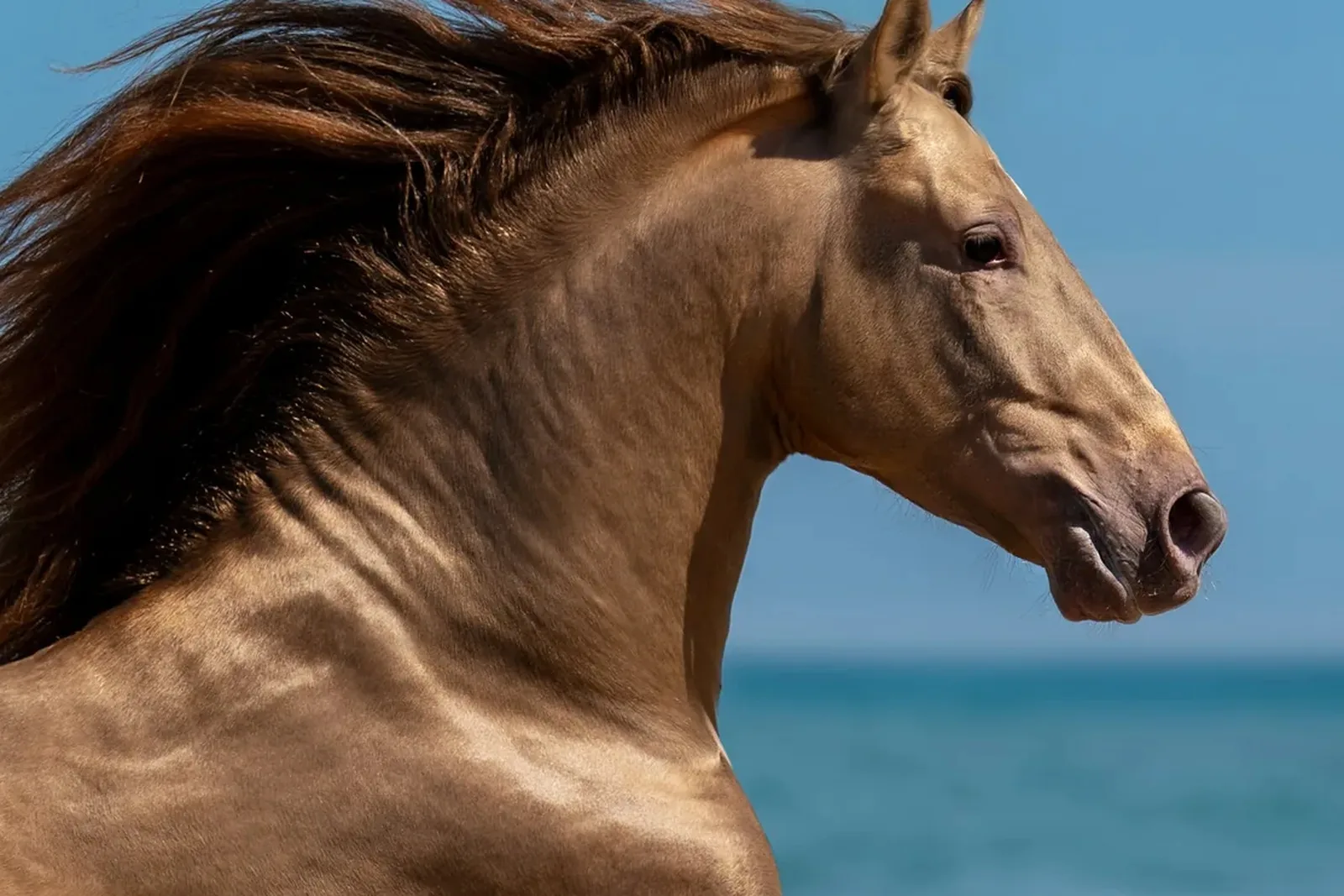
Palomino and buckskin get confused constantly, although you can separate them in two seconds and without a test. Both are made by the same gene. The only difference is what that gene landed on.
I will go through it in order, because for buying and for breeding these are two different horses.
One gene, two bases
Palomino and buckskin are both one copy of cream.
Cream dilutes red pigment and leaves black alone. Everything else follows from that.
On a chestnut base there is no black at all. Cream lightens the whole horse, mane and tail included. That gives you a palomino: golden body, pale mane.
On a bay base the black is there — in the mane, the tail and the legs. Cream lightens the body only, the black points stay as they were. That gives you a buckskin: sandy body with black mane, tail and legs.
On a black base there is almost nothing to dilute. That gives you smoky black, a colour the eye cannot separate from plain black.
How to tell them apart in two seconds
| Palomino | Buckskin | |
|---|---|---|
| Base | chestnut | bay |
| Body | golden | sand, from pale to dark |
| Mane and tail | white or flaxen | black |
| Legs | same tone as the body | black below the knee and hock |
| In Spanish papers | palomino | bayo |
Look at the legs and the mane. Black means buckskin. Pale means palomino. You can skip the rest.
The mistake happens when a buckskin's body is very light and the mane has bleached out in the sun. Then the legs settle it: cream never lightens black hair below the hock.
Shades within each one
Palomino runs from nearly white — isabella palomino, light palomino — to a deep gold that reads almost chocolate. The spread is wide, and it depends not on cream but on how dark the chestnut base underneath was.
Buckskin is more varied still: from creamy sand to dark buckskin, where the body is nearly brown. Buckskins often carry a dark mask over the face. That is not sooty shading and not a fault, it is an ordinary variant.
None of these shades is a colour of its own. The papers will say palomino or bayo, and that is all.
What gets called palomino by mistake
Four colours that photograph the same way.
Double pearl on a chestnut base. Golden body, pale mane, pale skin. In a photograph there is nothing to go on. You separate them by the eye — pearl eyes are amber or greenish — and by the test. The difference shows up in the offspring: a palomino passes cream to half the foals, a double pearl to all of them.
Cremello and perlino. Lighter than palomino, pink skin, blue eyes. That is two copies of cream, not one. In detail here.
Silver dapple on black. Chocolate body with a flaxen, almost white mane. No cream involved at all, a different gene entirely. The body stays a true dark brown rather than going gold. The same trap works with a flaxen chestnut, which is red where a palomino is golden.
A light chestnut with a bleached mane. By August, out in the sun, a horse like that looks palomino. By January it has stopped.
I live with this confusion daily: my stallion is a bay double pearl, and in three years he has been called palomino three times. On the beach in side light the difference genuinely is not visible.
What cream does in the foals
Palomino and buckskin are heterozygous for cream. One copy of cream, one ordinary copy.
Half the foals get cream, half get nothing. That cannot be steered or improved by matching. It is probability and nothing else.
What the half that did get cream turns into depends on the base coming from the other parent:
- chestnut base plus cream = palomino
- bay base plus cream = buckskin
- black base plus cream = smoky black
Two palominos can produce a cremello, if cream arrives from both sides. The odds of that are one in four.
And the limit that outweighs the rest: grey paints over any cream. One grey parent, and the foal will go white by ten regardless of what it inherited. How that works I went through in the article on grey.
Price and market
Dilute colours are rare in the PRE and cost more. Going by Spanish listings of the last few seasons, a palomino or buckskin youngster with the same conformation and pedigree sits one and a half to two times above a bay of the same age — the difference between roughly 8,000 € and 15,000 € for a weaned colt out of an average stud. Nobody publishes proper statistics for the breed, so that is a range read off advertisements rather than an official figure.
The extra money is paid for the colour, not for the movement. That is fine as long as you know what you are paying for. Colour sells first and works last: under saddle it is not there.
One word on honest wording. A seller who writes palomino about a double pearl is usually not lying — he sees a golden horse and reaches for the familiar word. What needs checking is the laboratory report, not his conscience.
If this is the horse you are looking for
I find and buy horses in Spain, and dilute colours are what I get asked about most. The order of work does not change: genotype of both parents first, then conformation and movement, and only after that the photographs in evening light.
The full list of colours with their Spanish and English names is here. How a particular pairing is calculated is on the breeding page.