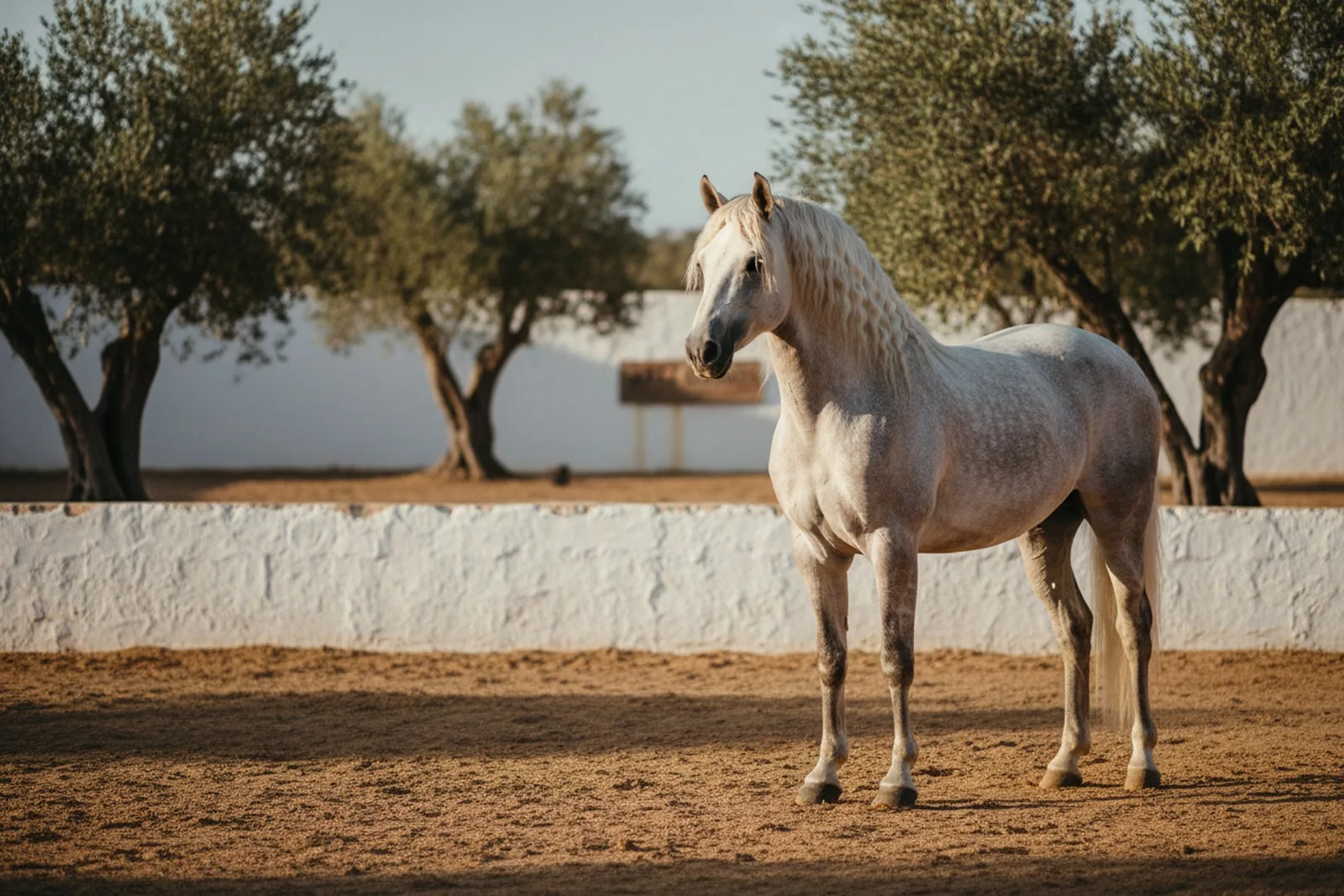
Cremello, perlino and smoky cream explained
How cremello differs from perlino and smoky cream, where the blue eyes and pink skin come from, and why a double-cream horse is not a double pearl.
"Cremello" in an advert means roughly anything pale. It has been written to me about my own stallion six times, and never once correctly. In reality the double-cream colours are one specific arrangement of the genome, and there are exactly three of them.
Here is how cremello differs from perlino and smoky cream, and why none of it has anything to do with pearl.
One gene, two doses
These colours are made by the cream gene. It dilutes, and it works in doses.
One copy of cream lightens red pigment only. On a chestnut base that gives palomino, on bay buckskin, on black smoky black, which the eye can hardly separate from plain black.
Two copies lighten everything, black included. The body goes the colour of clotted cream, the skin turns pink, the eyes blue. That is the double-cream group.
Hence the main misunderstanding. This is not one colour but any of the three bases under double cream. That is why it has three names, and why the papers carry one of those three rather than a single blanket word.
Cremello, perlino, smoky cream
| Name | Base | Body | Mane and tail |
|---|---|---|---|
| Cremello | chestnut | even cream | same tone or lighter |
| Perlino | bay | cream | noticeably redder than the body |
| Smoky cream | black | cream with a greyish cast | dirty, smoky |
The difference between them is smaller than the difference between two photographs of the same horse in different light. By eye, perlino is told from cremello by the mane: the black pigment has not gone anywhere, it has only been diluted, and in the mane it reads as a copper or rusty tone.
Smoky cream is the hardest of the three to recognise. It usually gets written down as perlino, and everyone lives with that until the first genetic test.
Blue eyes and pink skin
The blue eye frightens buyers more than anything. There is nothing to be frightened of, and nothing to ignore either.
There are no albino horses: the homozygous form is lethal, and no living albino horse exists. A double-cream horse has pigment, it is simply diluted a long way.
What does need attention is that pink skin burns. Muzzle, nostrils, eyelids, every hairless spot. In Valencia I watch it happen every summer to the neighbours' pale horses: without sun cream on the muzzle they have scabs by July.
The eyesight is normal. Sensitivity to bright light can be slightly higher, but in work it barely shows.
Double cream against double pearl
This is the pair people get wrong most often. I live inside it: my stallion is registered in the LG PRE ANCCE studbook as bay double-pearl.
Pearl sits at the same locus as cream but paints a different picture.
| Double cream | Double pearl | |
|---|---|---|
| Body | clotted cream | golden, with a metallic sheen |
| Skin | pink | light, but not pink |
| Eyes | blue | amber or greenish |
The blue eye settles it in a second. Blue means cream. Amber means pearl. I have written about pearl separately, and about the dilutes as a whole here.
There is a third case nobody mentions: one copy of cream plus one copy of pearl. Such a horse looks close to a double cream, but the pearl allele in it behaves differently. Only a test will tell them apart.
Double cream, white and grey are three different things
Three mechanisms produce a near-white horse, and confusing them is expensive.
Double cream. Pink skin, blue eyes, a cream body rather than a white one. Born that way and unchanged for life.
Grey. Born any colour and whitens over years. The skin under the coat is dark, the eyes are dark. How that works is further on.
Dominant white. Rare, confined to a handful of lines. Pink skin, but dark eyes — and that is exactly what separates it from cremello.
What the Spanish papers say
If you are reading PRE documents, the colour box will hold perlino or cremello, spelled out. Spanish has no separate word of its own here, the international terms are used. That is one reason the same horse ends up recorded differently in two documents.
There are few double-cream PRE. Cream exists in the breed but is uncommon, and at equal conformation such a horse costs more than a bay or a grey. Worth knowing before you fall in love with a photograph — and worth factoring into an import budget, where colour premium and transport land in the same spreadsheet.
What a double-cream horse gives its foals
Here everything is arithmetic rather than hope.
A double-cream horse is homozygous for cream. Every foal it produces gets exactly one copy of cream — not half of them, all of them. How that copy shows depends on the other parent's base: chestnut gives palomino, bay gives buckskin, black gives smoky black.
You cannot get a second double cream out of a double cream and an ordinary horse. Two copies need cream from both sides.
And the same limit applies as with pearl: the grey gene beats everything else. A grey parent gives a foal that will whiten by about ten, whatever is lying under the white hair.
If you are working out one particular horse
I find and buy horses in Spain, and colour is the single most common source of disagreement between seller and buyer. The seller writes what he sees. The passport holds what was written down when the foal was chipped. The test shows a third thing, and the test is right.
The order is simple: the lab report with the genotype first, photographs second. How Spanish paperwork reads I have covered here, and the full list of colours with their names is here.