"Dilute coat colours: palomino, buckskin, cremello"
How palomino differs from buckskin, where cremello and perlino come from, and why the same horse is written up differently in different papers.
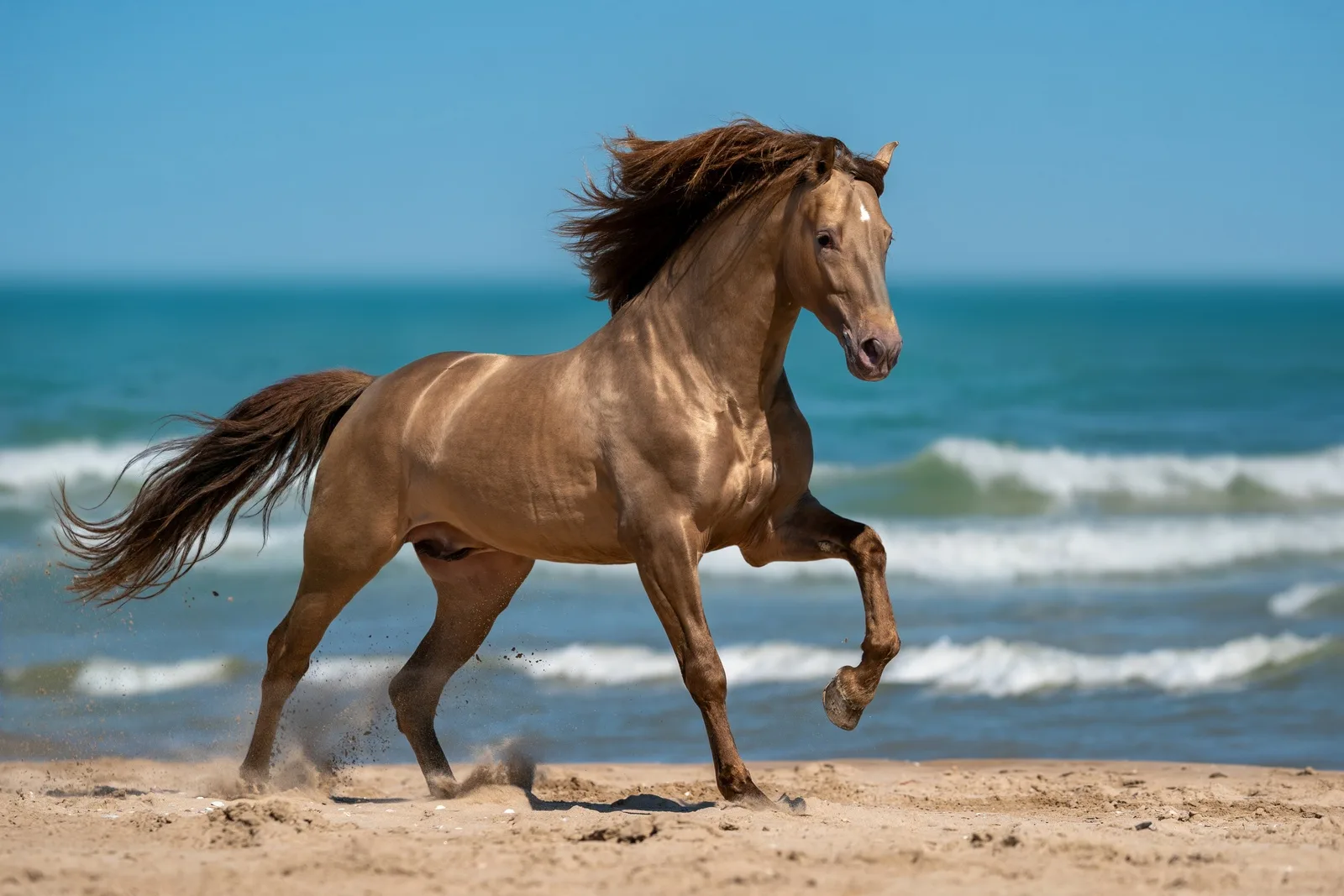
A horse's coat colour is not the colour of the hair. It is which genes the foal got from its parents and how those genes worked together. Looked at with the eye, colours seem to run into the hundreds. Read the papers and it turns out there are three base colours, and everything else is a dilution laid over them.
I did not learn this out of an interest in genetics. I stand a double pearl stallion and I offer his semen. Mares are matched to him on colour, and if the breeder is wrong about the base, he gets a result he was not expecting.
The three bases everything grows from
Start with the base, not with the dilutions.
Black. Black hair over the whole body, black mane and tail. On Spanish papers, negro.
Bay. Brown body, with mane, tail and legs below the hock black. The most common base in the world. On Spanish papers, castaño.
Chestnut. Red hair everywhere, mane and tail included. No black pigment at all. On Spanish papers, alazán.
The dilutions sit on top of that base. There are several of them and they work differently. Which is why horses that look identical can be registered differently, and horses that look nothing alike can be registered the same.
Cream: palomino, buckskin, cremello
The best known dilution. It is incompletely dominant: one copy does one thing, two copies do something else entirely.
One copy of cream on chestnut is palomino. Golden body, white or nearly white mane and tail.
One copy on bay is buckskin. Sandy or yellow body, black mane, tail and legs. These two are the pair confused most often, and palomino or buckskin is settled by the mane and the legs rather than by the body.
One copy on black is smoky black. Visually it is close to an ordinary black, sometimes a shade more prone to sun-fading. This one is identified by test only, and the eye misses it constantly.
Two copies of cream give the double dilutes. Cream-coloured body, pink skin, blue eyes. Depending on the base these are cremello, perlino or smoky cream — the three are broken down in cremello, perlino and smoky cream.
The key point about two copies: double cream always comes with blue eyes and pink skin. Brown eyes and dark skin mean it is not double cream, whatever the advertisement says.
Champagne, silver and pearl
Cream is not the only dilution, and this is where the mistakes start.
Champagne lightens the body and at the same time gives mottled skin around the eyes and muzzle; the foal is born with blue eyes that darken to amber. Champagne turns up in American breeds. PRE does not have it.
Silver lightens black pigment only. On a black base it gives a chocolate body with a pale mane; on chestnut it shows nothing at all. Spanish horses do not carry silver either.
Pearl is a separate gene living at the same locus as cream. One copy of pearl is close to invisible: the horse looks like an ordinary chestnut or bay, a shade lighter at most. Two copies give a golden body, pale skin and pale eyes, but not blue ones. Pearl is found in the Iberian breeds — PRE, Lusitano — and in American Quarter Horses.
I wrote about pearl separately, because it is the colour most often confused with a double cream and with palomino.
Grey overrides everything
A separate story, and one that costs breeders money.
Grey is dominant and progressive. The horse is born any colour at all, then greys year by year until it is white. By ten the original colour is gone from view. The mechanism is in grey coat colour.
Here is what matters: grey does not replace the genotype, it paints over it. A white horse can be carrying a bay base or a double pearl underneath, and it will pass that on.
From which the working rule: if the mare is grey, the foal's colour cannot be predicted from a photograph. You need a test. Without one you do not know what you are crossing.
Why one horse is written up differently
Registries record colour differently, and that is normal.
- LG PRE ANCCE, the Spanish stud book, records the base colour in Spanish and lists the genetic tests separately, where they have been done.
- Registries outside Spain translate into everyday names, where one word can cover several different genotypes.
- The seller may write palomino in the advertisement because that is what the horse looks like, while the genes underneath say pearl.
My Godo PM is registered as bay double-pearl — double pearl on a bay base. An advertisement would call him palomino. They are not the same thing: palomino is made by cream, this is pearl, and the offspring come out differently.
What a breeder should do about it
Three things that save a year.
First: test the mare before you match her, not after. A cream and pearl test costs less than one wasted season. What the lab actually reports is in the coat colour DNA test.
Second: do not trust a photograph. A palomino and a single-copy pearl on chestnut are indistinguishable in a picture, and they give opposite results in a breeding.
Third: look at skin and eyes. Pink skin and blue eyes mean double cream. Pale skin and amber eyes mean double pearl. Dark skin means neither, however much gold there is in the coat.
If you have a bay or chestnut mare and want to see what a pearl stallion would give, the breeding page has a grid that works it out in one click.