Grey horses: why they turn white
How the grey gene works, how many years it takes a horse to whiten, how grey differs from white and roan, and why grey horses get melanomas so often.
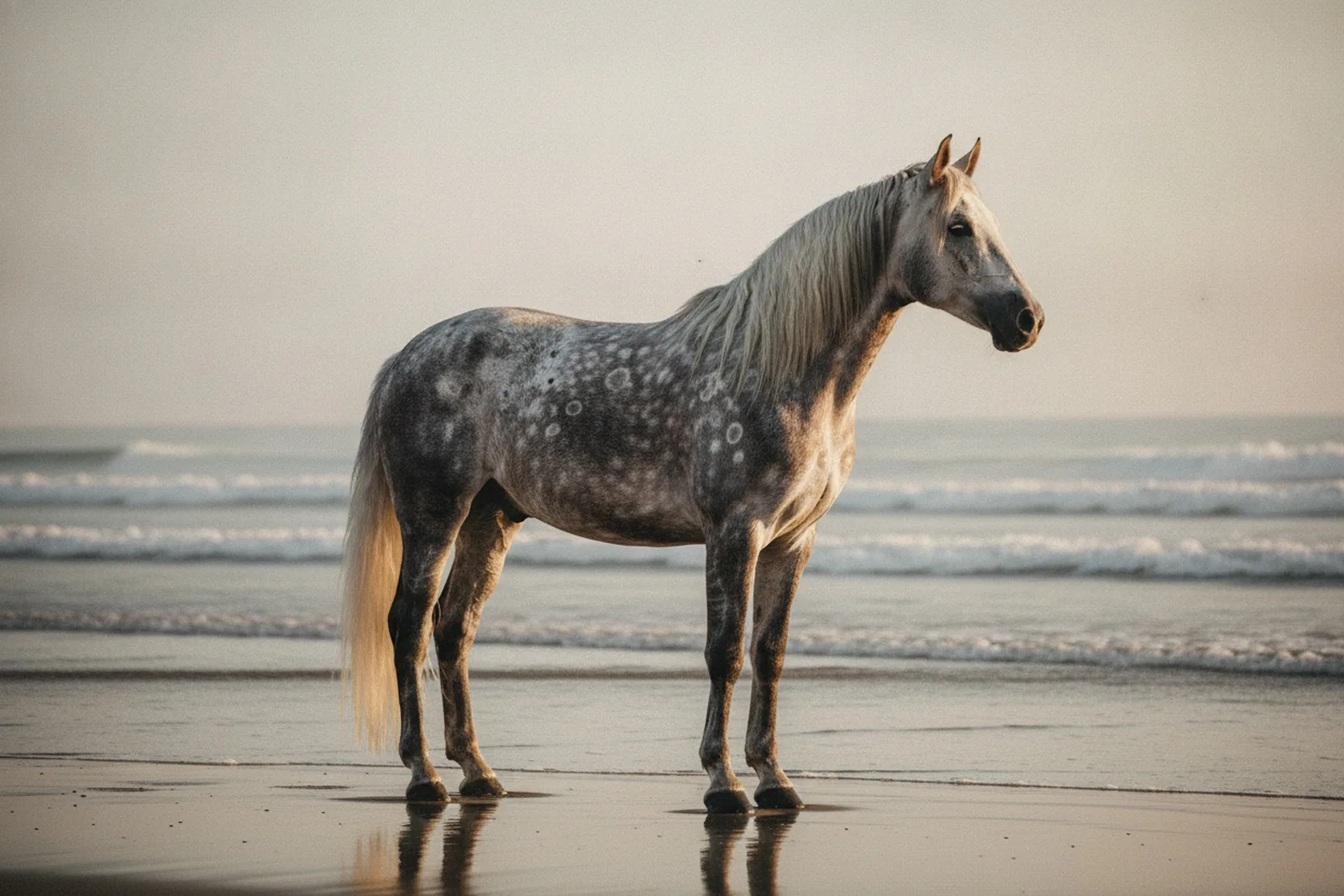
A grey is the one horse whose colour you cannot state. The answer depends on which year you are looking. At two it is dark, at six it is dappled, at twelve it is nearly white.
Here is how that works and what follows from it for a buyer.
The grey gene behaves unlike the others
Every other colour a horse is given at birth and carries for life. Grey works differently, for two reasons.
It is dominant. One copy is enough. A grey parent means either a grey foal or an honest one-in-two chance, if that parent is heterozygous.
It is progressive. Its effect accumulates year on year. The mutation was found in the STX17 gene, a Swedish group published the work in 2008, and zygosity for grey has been a test result ever since.
A grey is not born grey. It is born black, bay, chestnut — anything. The first sign of the greying to come is light hairs around the eyes and on the muzzle of the foal. They show before anything else does.
How it goes by the year
| Age | What you see |
|---|---|
| under 1 | the birth colour, light hairs around the eyes |
| 2–4 | dapples over the body, head and legs still dark |
| 5–8 | light grey, the dapples fading out |
| 9–15 | almost white, dark skin under the coat |
| over 15 | white, often flea-bitten with dark or red flecks |
Timing is individual. A homozygous grey whitens noticeably faster than a heterozygous one — sometimes almost completely by six. A black base usually greys more slowly than a chestnut.
Dapples and flea-bites are stages, not colours
Dappling is light rings over the body on a darker ground. It is a stage rather than a property of the horse: in a few years the dapples will go, and nothing brings them back.
Flea-bitten is the dark or red flecks that come through on an already white body. That one runs the other way: the older the horse, the more of them. When the flecks are red and dense, such a horse is sometimes called a red roan grey or blood-marked.
Neither goes into the papers as a colour of its own. The passport will simply say grey.
Telling grey from white and from roan
Three checks that work without a test.
Skin. On a grey it is dark under any amount of white hair. Part the coat on the shoulder, or look at the muzzle around the nostrils: it will be grey or black. On a true white and on a cremello the skin is pink.
Eyes. A grey has dark eyes. Blue eyes with a pale body mean cream, which means one of the double-cream colours.
Change over time. A roan has white hair mixed through the coat from birth and does not lighten with age. A grey lightens every year. Two photographs three years apart are enough.
Melanoma: the real drawback
This has to be said plainly, because a grey is most often bought for its looks.
Melanomas occur in grey horses incomparably more often than in any other colour. Veterinary reviews give various figures for greys over fifteen — usually somewhere between 70 and 80 per cent. The exact number depends on the sample, but the order of magnitude is the same everywhere.
They grow in characteristic places: under the tail, around the anus, on the lips, on the jowls, at the sheath. Most grow slowly and do not stop a horse working for years. A share of them turn malignant.
I am not a vet and I will not discuss treatment. I will say only what I do myself: when examining a grey over ten, you look under the tail, without exception, and that is not squeamishness but part of the pre-purchase exam. Any vet doing a five-stage exam for an export buyer will do the same, and the finding belongs in the report, not in a conversation afterwards.
Grey in the PRE
Grey is the most common colour in the breed. In Spanish documents it stands as tordo. Scroll through any stud's sales list and you see it at once: more greys than all the other colours put together.
The reason is historical. The breed was selected for centuries for parade work, and a pale horse showed better in the arena. Selection on colour ran for generations and the gene fixed itself. The same thing happened to the Lipizzaner, bred in Vienna out of Spanish stock and today grey almost without exception.
The practical conclusion for a buyer is straightforward. A grey PRE is the norm and carries no premium. What costs more is what is rare in the breed: black, palomino, buckskin, pearl.
Why grey wrecks a colour plan
This is where grey stops being cosmetic.
Grey does not replace the genotype, it paints over it. Anything can be lying underneath — a black base, cream, pearl. The horse carries all of it and passes it on, but you will not see it in her, nor in half of her foals.
Putting a pale stallion under a grey mare makes no economic sense. The foal will inherit the pearl or the cream and whiten by ten regardless. I wrote about that in the article on double pearl — for matching a pair it is the first thing to check.
Only a zygosity test saves you. A heterozygous grey passes grey to half its foals, a homozygous one to all of them without exception.
What to do about it when buying
If you are choosing a horse and want to know what will be under the white hair in five years, work from the parents' genotypes, not from a photograph of the foal. The grid that does the arithmetic is on the breeding page.
And if you want a grey horse to stay grey, keep the calendar in mind: the foal you are looking at now, dark, will be a visibly different horse in six years. The full list of colours with their names is here.