The Cartujano line: what Cartujano actually means
Where the Carthusian line of the Spanish horse came from, how Cartujano differs from the rest of the PRE and why the label gets sold as a breed.
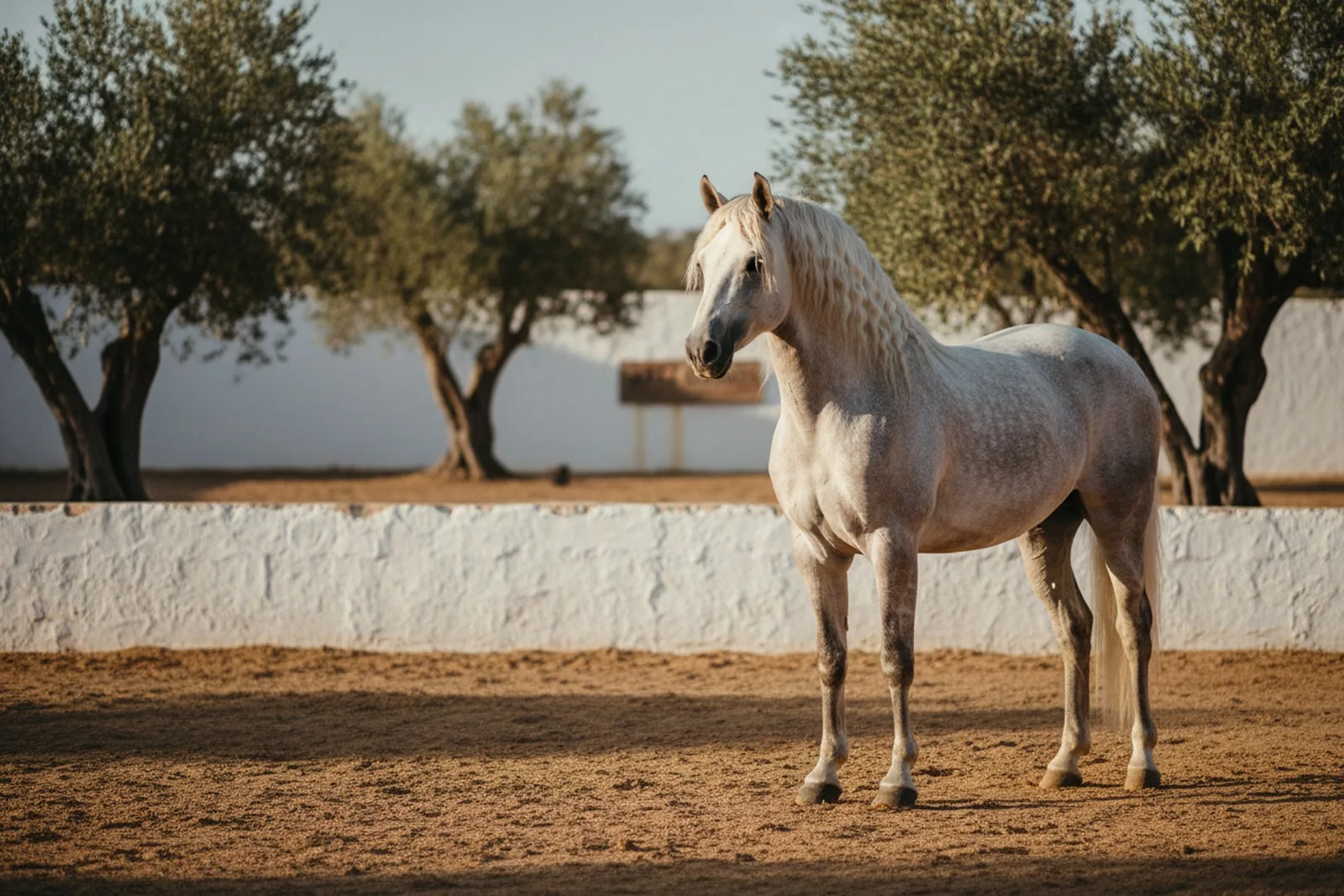
Cartujano is not a breed. It is a historical line inside the Pura Raza Española, and a horse with that pedigree is entered in the same studbook as any other Spanish horse: LG PRE ANCCE in Seville. There is no separate book, no separate standard and no separate inspection for it.
I am going through this in detail because a whole layer of selling has been built on the label. I keep a PRE stallion and I look at horses in Spain for work, so "Carthusian blood" in an advertisement is something I run into regularly.
Where the line came from
The Carthusian monastery of Santa María de la Defensión in Jerez de la Frontera was founded at the end of the fifteenth century: a local man, Álvaro Obertos de Valeto, left the monks land and livestock in his will. The livestock came with horses.
The monks bred them for several centuries, in one place and to their own judgement. The key episode of the tradition runs like this: in the eighteenth century the crown ordered the Spanish horse improved with Neapolitan and central European blood, and the Carthusians avoided the outcross and carried on with the old type. How literally that happened is hard to judge — the story survives in retelling, and there are no documents for every step of it.
After that the stock changed hands. In the early nineteenth century, after the Napoleonic invasion and the church seizures, the horses were bought by a Jerez horse owner, Vicente José Vázquez. His herd was divided after his death: part went to the state remount breeding programme, part to private Andalusian breeders, among them the Zapata, Terry and Bohórquez families.
The brand of the line is the hierro del bocado, a mark in the shape of a curb bit. That is how the line is recognised in old pedigrees.
The ESCLAVO legend
The whole line is traced to a single founder, a stallion called ESCLAVO who lived around the turn of the eighteenth century. Two traits are said to come down from him: growths under the root of the tail and small horny lumps on the forehead.
The traits exist, the inheritance is not proven. They turn up in horses outside the line and are missing in part of the Carthusians. A seller who shows you the "horns" as confirmation of blood is showing you folklore, not a document.
Yeguada de la Cartuja today
The historic stock is held at Yeguada de la Cartuja — Hierro del Bocado, outside Jerez. It is state-derived, runs the line as a separate breeding programme, and is open to visitors: there is a regular presentation of stallions and broodmares. The schedule is seasonal and worth checking before you travel.
This is the only place where the Carthusian group exists as a closed population with a plan behind it. Everything else is private studs using Carthusian sires alongside all the others.
How it differs from the rest of the PRE
I will say it at once: there is a difference, and it is smaller than the advertising makes it sound.
| Trait | Carthusian group | PRE overall |
|---|---|---|
| Studbook | LG PRE ANCCE | LG PRE ANCCE, the same one |
| Coat colour | almost entirely grey | grey, bay, black, dilutes more rarely |
| Head | drier, profile straight or slightly convex | wider spread, convex more often |
| Height | middling, no extremes | from 155 to 165 cm and above |
| Type | more uniform within the group | more varied between studs |
| Genetic diversity | lower, long bred within itself | higher |
That last row is the most important one and the least popular. The line is valued precisely because it was kept closed, and for the same reason its level of inbreeding runs above the breed average. For a breeder that is work to be done in the mating decision, not a thing to be proud of.
I have not met dilute coat colours in the Carthusian group: pearl and cremello come into the PRE from other lines.
What the papers say
Short and unambiguous here. There is no line reading "cartujano" in a PRE passport.
There is a number in LG PRE ANCCE, a UELN, the measurements, the pedigree and the breeding qualifications that the association awards on conformation, movement and offspring. Those qualifications are the same across the whole breed; there is no separate Carthusian one.
The only thing that confirms the origin is the pedigree. You open it out to four or five generations and look at whether the ancestors come from Yeguada de la Cartuja and from the historic Carthusian breeders. How that reads in practice is in how to read a pedigree. What a Spanish horse should have in its file at all is in Spanish horse papers.
Why the label sells
The mechanics are simple. The word sounds like a separate breed, it is hard to verify from outside Spain, and verifying it costs the seller nothing.
Three moves I see most often.
"One hundred per cent Carthusian blood." There is no single method of calculating it. Different breeders count from different ancestors and to different depths, and the same horse comes out as full-blood with one seller and half with another.
A surcharge for the word. Sellers charge extra for "cartujano" when it brings no index, no admission and no line in the passport. You are paying for the word.
Swapping the argument. The line gets talked about instead of the horse being shown: the measurements, the movement, the radiographs of the joints. A pedigree does not cure a hock.
The honest position: Carthusian origin is a fact of the horse's biography, not a grade for its quality. A good Carthusian is good on his own merits, and a bad one stays bad with any pedigree behind him.
How to check, if one is offered to you
- The LG PRE ANCCE number and the UELN. Without an entry in the register, outside Spain the horse is not a PRE, and the conversation about the line loses its point.
- The pedigree to four or five generations. Look at the actual studs and names, not at the wording of the advertisement.
- The brand. A hierro del bocado on a horse of the corresponding origin is an extra marker, but on its own it guarantees nothing.
- The vet exam before the money. The order is the same as with any other horse, and the line does not suspend it.
What I do
Godo PM is not a Carthusian. He is a 2022 colt, bay double pearl, by SOL PM II out of CASIA PM, bred at Yeguada Paco Martí in L'Alcora. That is a different part of the breed, and I say so plainly so there is no ambiguity.
I look at Carthusian horses for work, when a client wants exactly that type: drier, more uniform, all but guaranteed grey. My condition is one and it is the same for any purchase — papers and exam first, conversations about the line afterwards. How I go about it is on the services page.