Andalusian horse (PRE): breed, character, price
How a PRE differs from a Lusitano and from a registry Andalusian, what the character is really like, and what the breed costs in Spain.
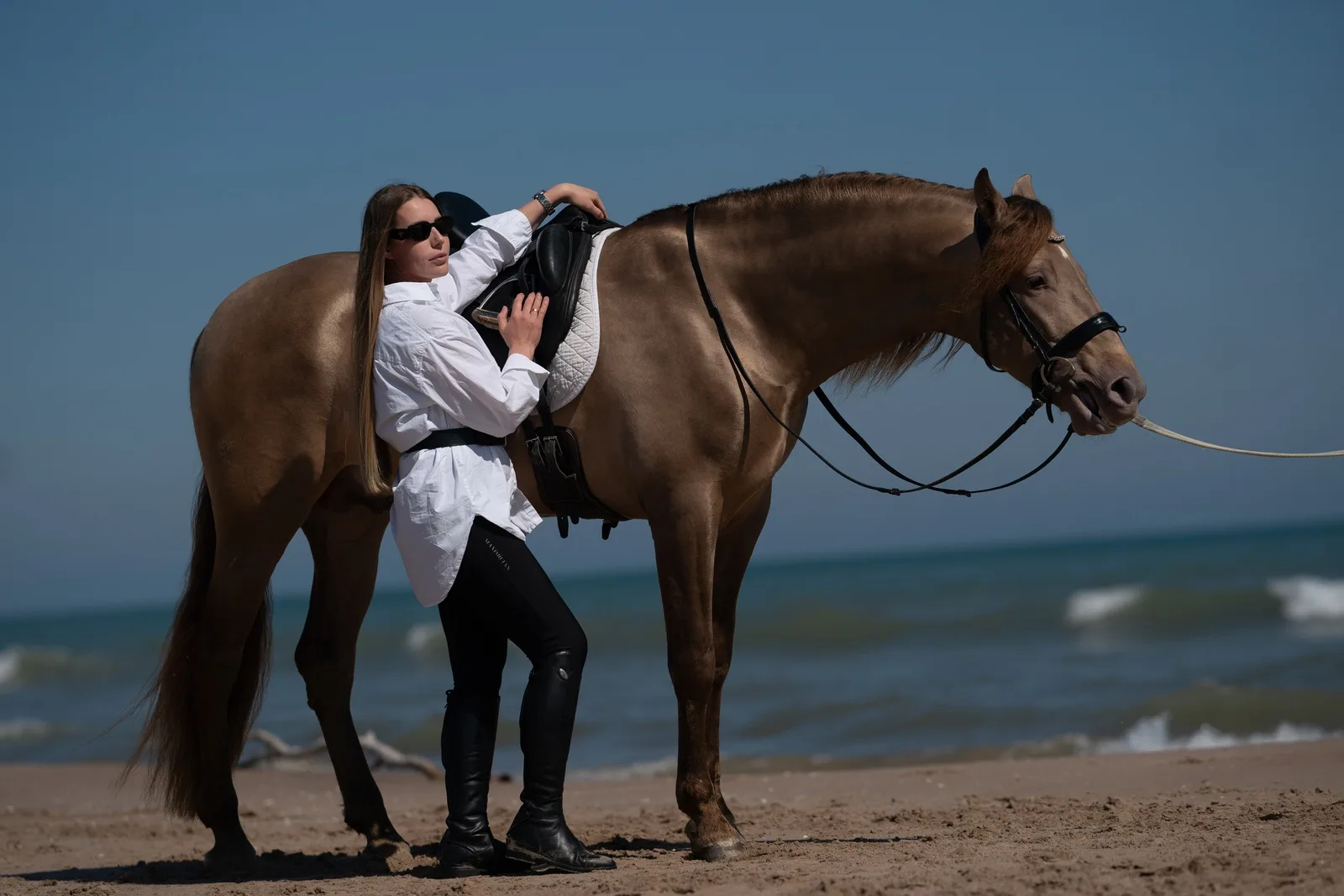
"Andalusian horse" is a household word. On paper the breed is called Pura Raza Española, PRE for short. There is one official studbook: LG PRE ANCCE in Seville, recognised by the Spanish Ministry of Agriculture. Everything else is a regional register or a private book, and outside Spain those interest nobody.
That distinction matters more abroad than it does here. In North America "Andalusian" is also a registry name, and that book takes Spanish blood, Portuguese blood and crosses of the two. A horse can be an Andalusian under it and not be a PRE. If you ever plan to breed, to resell in Europe or to show under Spanish rules, the ANCCE entry is the only line that counts.
I live in Valencia and I keep a PRE stallion. What follows is what I see from the inside, not what gets copied out of encyclopaedias.
What the breed looks like
From 155 to 165 cm at the withers, roughly 15.1 to 16.1 hands. Not a giant. A powerful neck set high, a short back, a rounded croup, movement that comes up and collected without being asked.
Mane and tail are heavy. That is not grooming, that is the breed: Spain selected this horse for parade work for centuries, and hair was part of the selection.
Coat colour is mostly grey, then bay and black. Dilute coat colours — palomino, buckskin, pearl — are rare and cost more.
PRE and Lusitano
The question I get most often.
Both are Iberian and closely related. They split along the border: PRE in Spain, Lusitano in Portugal. From there the selection went two ways.
The PRE was bred for the arena and the parade. Hence the collected movement, the high neck set, the calm work in front of a crowd.
The Lusitano was bred for the bullring. Hence more sharpness, more turn, more willingness to take a confrontation.
For a buyer the difference lands in temperament: a PRE is usually quieter and simpler in daily work. The two side by side are a longer conversation, set out in Lusitano vs PRE.
Character: what is actually true
The PRE gets described as clever and willing. That is half right.
The breed is genuinely people-oriented. A PRE stallion will usually work calmly in company, in situations where a stallion of another breed would already be making a scene.
But people-oriented is not the same as trouble-free. The PRE is very sensitive to inconsistency. He learns fast what he is allowed, and he learns just as fast that he is allowed to walk over you. You cannot work this breed one way on Monday and another way on Thursday.
Second point: looking mature early is not being mature early. A yearling PRE looks older than he is. Starting him before three ruins him.
What it costs
The spread is wide and the reasons are plain. Prices in Spain, at the breeder, transport not included.
A foal under a year without a standout pedigree — €4,000 to €8,000. That is buying blind: the conformation has not formed, the movement has not been shown.
A young horse of two or three, started — €10,000 to €20,000. You can see what grew, but there is no competition record yet.
A horse with a breeding qualification or a sport result — from €25,000 up, with no ceiling.
A rare coat colour moves the price noticeably. A double pearl or a palomino runs one and a half to two times the price of a bay of the same age, everything else being equal.
A Carthusian pedigree moves it the same way, and more often than it should: what cartujano actually means is worth reading before you pay extra for the word.
To the price of the horse you have to add honestly what comes after it: the pre-purchase exam, the export paperwork, the transport and the quarantine. Transport alone is a four-figure line and it is not the last one.
What to look at when buying
The order I work in myself.
Papers first, horse second. If the horse is not in LG PRE ANCCE, then outside Spain he is not a PRE, whatever he looks like. You can check the UELN against the open register in a minute.
The parents matter more than a photo of the foal. The foal will change shape three more times, the parents will not. Look at them.
ANCCE indices, where they exist. The breed calculates breeding indices for conformation and movement, with 100 as the breed average. An index flagged as low reliability comes from a small number of offspring, and it should not be read as a verdict.
Vet exam before the money, not after. Radiographs of joints and feet happen before the deal. A seller who refuses the exam has answered you with that refusal.
Importing a PRE
I will say this straight, and I say it although these are the horses I find for people.
A PRE is not a sport horse in the northern European sense. For serious show jumping the build is wrong. For amateur and mid-level dressage it works well, and for show, film and photography nothing beats it.
Upkeep is the same as any other horse. The breed is not fragile and does not need special conditions. The one thing it genuinely needs is regular work: a PRE handles standing still badly.
Climate is not a problem. A Spanish horse winters normally in Sweden or in Vermont if the barn is a normal barn.
Paperwork depends on where he is going. Inside the EU it is the horse passport, a health certificate and a TRACES entry — a truck leaves Valencia and is in Germany or the Netherlands in two days. Into the US it is another order of task: an import permit, a Coggins test, port quarantine on arrival, and for breeding stock CEM testing and quarantine at an approved facility that can run several weeks. Budget the time, not only the money.
If you are thinking about buying in Spain, that is the route I walk myself — the terms are on the services page.