How to read a horse pedigree
How the ancestor table is built, what an inbreeding pattern like 2×3 means, where linebreeding differs from inbreeding, and how to read ANCCE indexes.
A pedigree looks like a table of names, and most buyers give it about one second. It is the only document that tells you what a horse will pass on.
Here is how I read one.
How the table is built
A pedigree runs left to right. The horse sits on the left, generations open out to the right.
- First generation — sire and dam, 2 ancestors.
- Second — grandparents, 4 ancestors.
- Third — great-grandparents, 8 ancestors.
- Fourth — great-great-grandparents, 16 ancestors.
A four-generation pedigree holds 30 ancestors plus the horse itself. Four generations is the selling standard. Five and beyond get published when there is something worth showing.
In every pair the sire is on top, the dam underneath. That is a rule, not a layout choice: the position of the line tells you whether you are on the sire side or the dam side.
What to look at first
The sire. Half the genetics and usually all of the reputation. Look at his breeding qualification, his indexes and his produce.
The dam and the female line. Underrated everywhere. The dam gives more than genes: she feeds and raises the foal through the first six months, and her temperament shows up in what she produces.
Repeated names. If the same ancestor appears twice or more, that is inbreeding, and it gets measured.
Inbreeding: how it is written and what it means
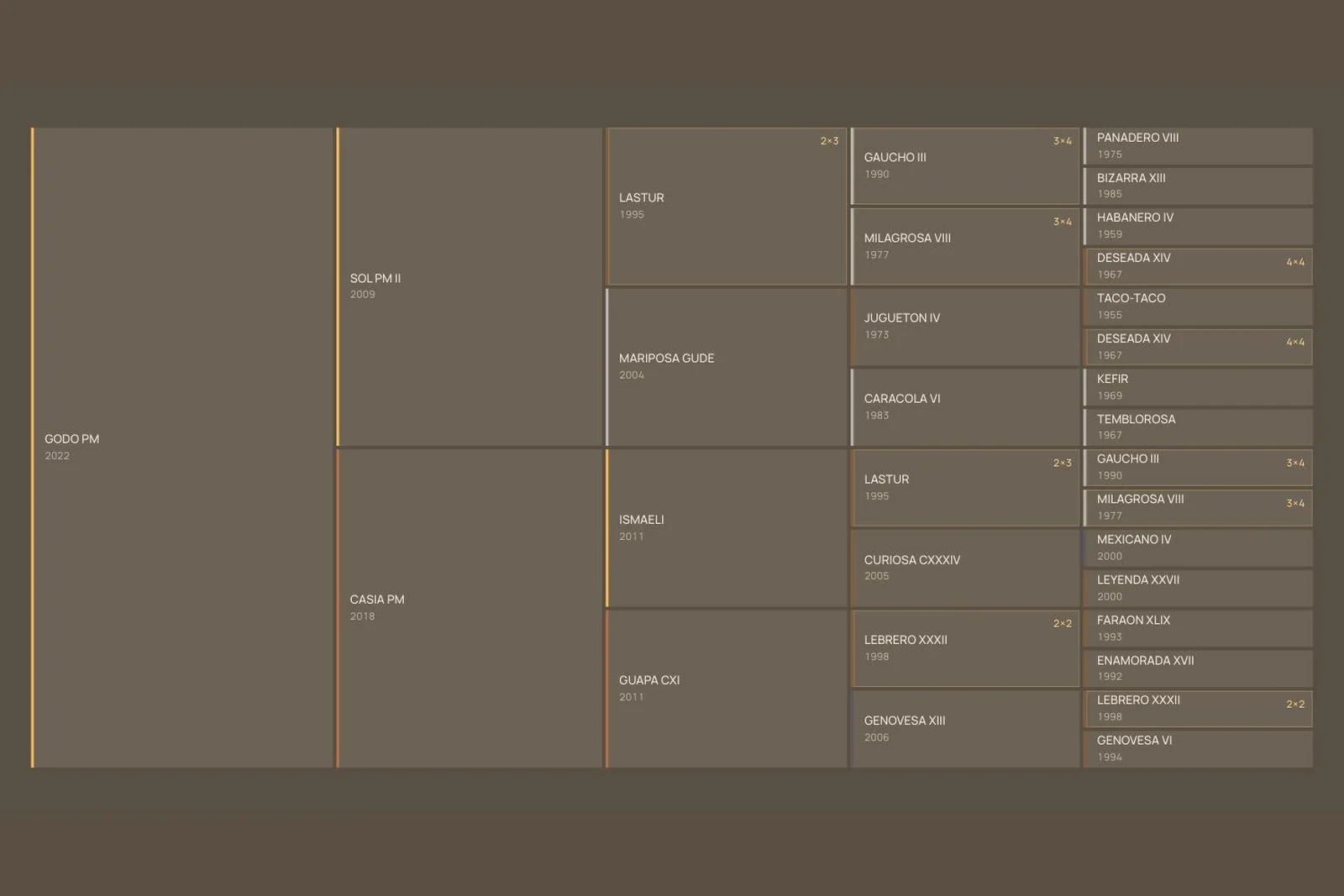
A repeated ancestor is written as a pair of numbers: 2×3, 3×4, 4×4. The figures are the generations in which that ancestor appears.
Read it like this: 3×4 means the ancestor sits in the third generation on one line and the fourth on the other.
The lower the numbers, the closer the breeding and the higher the risk.
- 1×2, 2×2 — close breeding. Not used in ordinary studbook practice.
- 2×3, 3×3 — tight. It works, but only if the repeated ancestor carries no hidden defects.
- 3×4, 4×4, 4×5 — moderate. This is how type gets fixed in a breed.
- beyond the fifth — almost no practical effect.
The numerical version is Wright's coefficient of inbreeding, given as a percentage. Under 6.25 % is normal for studbook breeding. Above 10 % you want a reason, in writing, from the breeder.
Linebreeding is not the same as inbreeding
The difference is intent.
Inbreeding is any mating of relatives.
Linebreeding is the deliberate accumulation of one outstanding ancestor's blood while keeping the distance under control. The breeder holds that ancestor at a safe remove, third and fourth generation, and repeats the pattern from one generation to the next.
Good linebreeding is visible at a glance: the same name several times, always far back.
My own stallion is a working example. LASTUR (1995) stands 2×3 in Godo PM's pedigree — sire's side and dam's side both. He carries a dressage index of 112.51 against a breed average of 100. GAUCHO III and MILAGROSA VIII, his own sire and dam, come back at 3×4 through him. Five ancestors in that pedigree appear twice. None of it is coincidence; it is what the stud farm was aiming at. I have published the whole chart with the indexes, look at it yourself.
ANCCE breeding indexes
The Spanish breed has something most breeds do not: calculated breeding indexes, published in the studbook and free to check.
ANCCE indexes three groups of traits — conformation, movement, functionality. Each trait is scored separately: head, neck, back, croup, limbs, walk, trot, canter.
The breed average is 100. An index of 106 means the horse is above average for that trait. An index of 94 means below.
Next to every index there is a reliability figure. It depends on how many evaluated offspring stand behind the number. An index of 112 with low reliability was calculated from three foals and may read 98 next year. An index of 106 with high reliability was calculated from a hundred and will not move.
Read both numbers. A seller who shows you the index and stays quiet about the reliability is showing you half of it.
What a pedigree does not tell you
Three things worth keeping in mind.
It does not guarantee a repeat. Genes segregate at random. An outstanding sire produces average foals regularly. That is biology, not fraud.
It does not replace an examination. A horse with an excellent pedigree can be badly raised, underfed through a critical window, or already injured. The pre-purchase exam is a separate job.
It says nothing about temperament. Temperament is heritable, but you cannot predict it from a table. For character, ask the people who have handled the horse.
What to do before you buy
First: check the pedigree in the registry, not in the advertisement. For PRE that means the UELN in the open ANCCE database. More on the paperwork in the article on Spanish horse documents.
Second: find the repeated names and work out the pattern. If you see 2×2 or 2×3, ask the breeder why it was done. There should be an answer.
Third: look at what is actually known about the parents. Indexes, qualification, offspring, competition record.
Fourth: do not pay for a famous name in the fifth generation. At that distance it affects nothing except the asking price.