Horse teeth: ageing, floating and calling a dentist
How many teeth a horse has, how age is read off the incisors, why the estimate falls apart after twelve, and who may legally rasp teeth in the US and Britain.
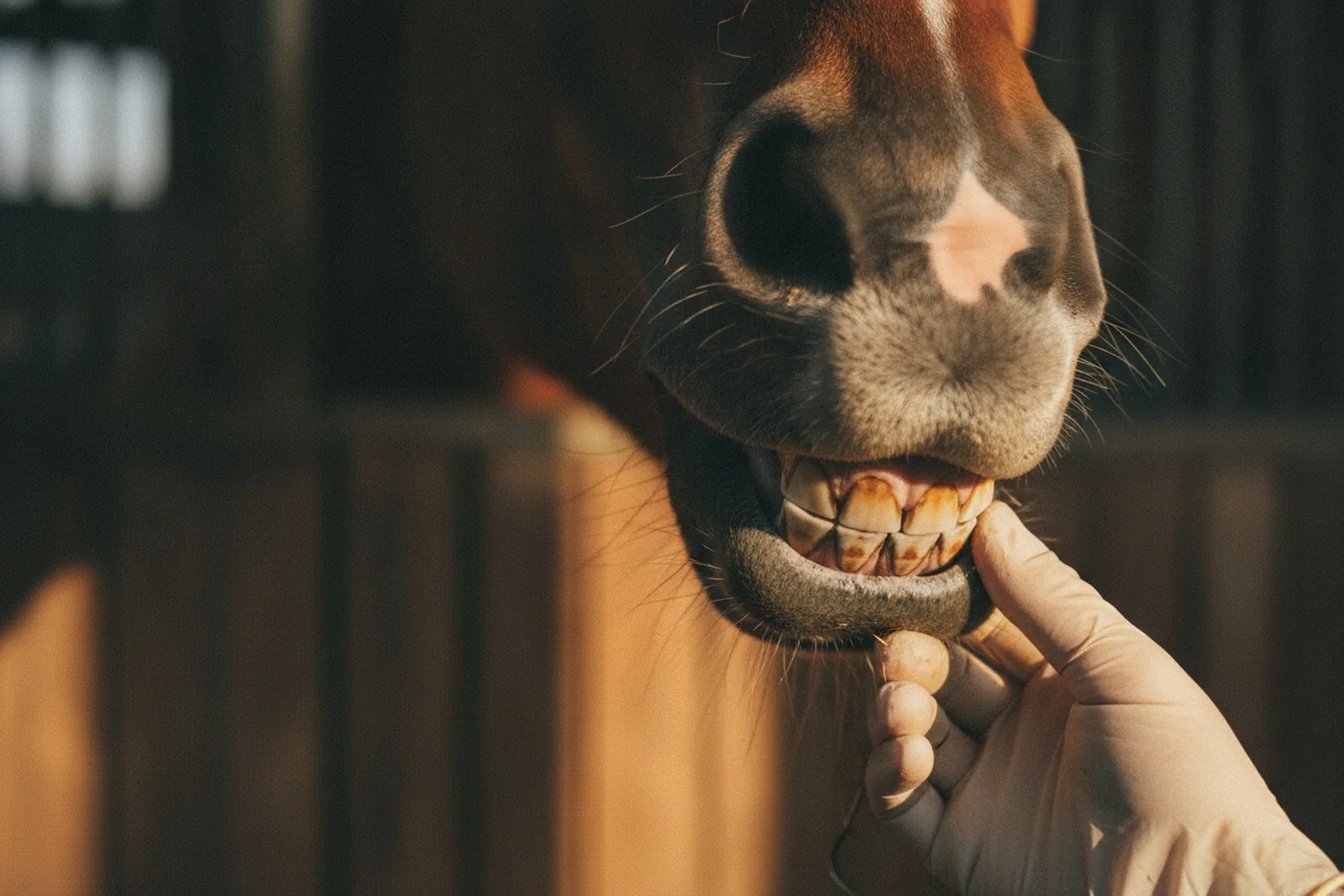
A horse's teeth erupt and wear down for its whole life. That is where ageing by mouth comes from, and it is also where the trouble comes from: the wear is uneven, and the sharp edges cut the cheeks.
The owner does two things here. Looks, and calls the right person in time.
How many teeth a horse has
It depends on sex and age.
| Horse | Teeth |
|---|---|
| Foal, deciduous set | 24 |
| Adult mare | 36 |
| Adult stallion or gelding | 40 |
| With wolf teeth | up to 44 |
The difference is the canines, or tushes. Stallions and geldings have them, mares usually do not, or carry small rudimentary ones. Wolf teeth are the vestigial first premolars sitting in front of the cheek teeth, and not every horse has them.
An adult mouth is 12 incisors and 24 cheek teeth, plus canines and wolf teeth where they exist. All of it is hypsodont: the crown is long, it keeps pushing up out of the jaw, and grinding wears it back down.
Reading age off the incisors
You look at the incisors: centrals, laterals and corners. The order is the same top and bottom, and the lower arcade is what people usually read.
| Age | What the incisors show |
|---|---|
| 2.5 years | centrals replaced by permanents |
| 3.5 years | laterals replaced |
| 4.5 years | corners replaced |
| 5 years | full mouth, the set is complete |
| 6 years | cups gone from the centrals |
| 7 years | cups gone from the laterals, a hook on the upper corner |
| 8 years | cups gone from the corners, dental star showing on the centrals |
| 10 years | Galvayne's groove appears at the gum of the upper corner |
| 15 years | the groove reaches halfway down the tooth |
| 20 years | the groove runs the full length |
| 25 years | the groove has grown out of the upper half |
The angle changes too. A young horse meets almost vertically; with age the incisors slope forward and close at an increasingly acute angle. The shape of the table goes oval, then triangular, then long from front to back.
Why the estimate falls apart after twelve
Up to five, age off the teeth is good to within six months. The deciduous set is replaced on a schedule and it is hard to be fooled.
After that you are reading wear, and wear depends on what the horse ate and what it stood on. Sandy ground, a concentrate-heavy diet, a habit of chewing timber — all of it speeds the table down. One horse at fifteen looks twelve, the next looks twenty.
After twelve the honest margin is plus or minus three years. After twenty, the answer is "aged".
Teeth are also faked. Cups are burned back in, incisors are cut and shaped, the groove is drawn on. The practice is old enough to have a name — bishoping. So at purchase you check age against the papers rather than the mouth. What belongs in those papers is in Spanish horse papers and the ANCCE studbook.
What happens on the cheek teeth
Age is read on the incisors. The problems live at the back.
The upper jaw is wider than the lower one, and the horse grinds sideways in a circular stroke. The tables wear at an angle and leave sharp enamel points: on the outside of the uppers, on the inside of the lowers. Where the arcades do not meet evenly you also get hooks at the front and ramps at the back.
Those points cut the cheek and the tongue. The horse keeps eating through it, up to a point. Then it starts dropping feed, losing condition and arguing with the bit, and the owner goes looking for the cause in its character.
Signs that mean you call someone
None of these get fixed at home.
- half-chewed feed dropping out of the mouth;
- hay rolled into packed wads and spat out, the classic quids;
- eating slower than usual, or refusing coarse forage while the appetite for soft feed is normal;
- weight coming off with no change in the ration;
- foul breath, drooling, blood on the bit;
- head tossing in work, leaning on one rein, refusing contact;
- swelling on the cheek or under the jaw;
- one-sided nasal discharge.
A routine oral exam is once a year. Twice a year for young horses shedding caps, and for anything over eighteen.
The examination is done with a full-mouth speculum and, in nearly every case, under sedation. Without both you are not seeing the cheek teeth, you are guessing at them. Reckon on 30 to 60 minutes. A routine float runs roughly $150–250 in the States and £70–130 in Britain, with sedation on top.
Who is allowed to do the work
This is where the answer changes with the country, and it is worth knowing before someone with a rasp turns up at the yard.
United States. Equine dentistry is the practice of veterinary medicine in most states, and sedation is a veterinary act everywhere. Some state boards license or tolerate lay equine dental providers working under veterinary supervision; others treat the same work as practising without a licence. The rule that matters is your state board's, not the practitioner's website.
Britain. The categories are set out and worth learning. Category 1 work — hand rasping of small overgrowths, removing loose caps — anyone may do. Category 2, which is where motorised rasping and wolf tooth removal under local anaesthetic sit, is for a vet or a qualified Equine Dental Technician who has passed the BEVA and BVDA examination; BAEDT membership is the practical proof. Category 3, extractions of cheek teeth and anything under general anaesthesia, is veterinary surgeons only.
Spain and most of the EU. It is a veterinary act, and the sedation settles the argument on its own. A dental technician works alongside a vet, not instead of one.
I stay away from the man with a rasp and no sedation. Blind rasping takes off the wrong thing in the wrong place, and correcting that afterwards costs more than the original job.
Wolf teeth and the bit
A wolf tooth sits exactly where the bit lies. If it is there and it interferes, the horse starts defending itself against the rider's hand, and the whole thing reads as a training problem.
The vet decides whether it comes out. Usually it goes before the horse is started, so a young horse never links the bit with pain. How starting itself is built is a subject of its own.
What I do
I am not a vet, and I do not put instruments in a horse's mouth. My list is short. One veterinary exam a year, and between exams I watch how Godo PM eats, whether anything drops, and whether the contact has changed.
Dentistry belongs in the annual running costs that first-time buyers forget to budget. The order of those numbers is in how much a horse costs. If you are buying in Spain and want the age and the mouth checked before any deposit changes hands, that is how it works.