How to fit a saddle to your horse
How to template a horse's back, what tree width really means, why a saddle is refitted when the horse changes shape, and how to read the sweat pattern.
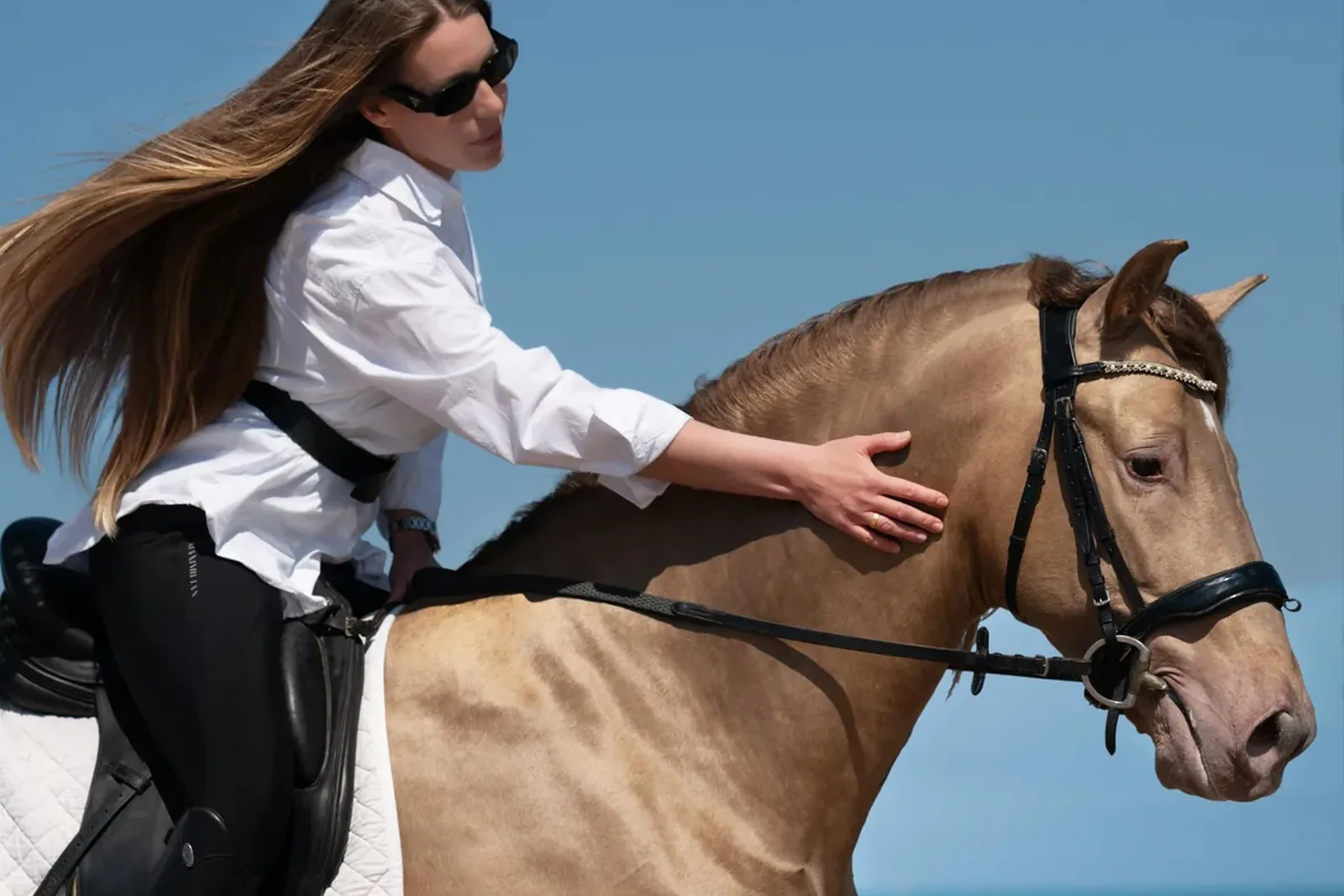
A saddle is fitted to one particular back. Not to a breed, not to a height, not to the rider — to the back of the horse standing in front of you today. And it is fitted again when that horse changes shape.
Four things that have to fit
Four, and none of them substitutes for another.
Tree width. The points of the tree have to follow the angle of the shoulder. Points that are too narrow pinch the withers; points that are too wide let the saddle sit down on them.
Panel shape and length. The panel lies along the muscle either side of the spine, evenly, with no bridging and no point of concentrated pressure.
Saddle length. The weight-bearing part does not go past the last rib — about the eighteenth thoracic vertebra. Behind it there are no ribs, only loin.
Seat size. This is the one measurement taken for the rider rather than the horse.
Templating the back
You need a flexicurve — the drawing tool from any art or hardware shop — or a length of soft wire.
- Stand the horse square on a hard, level surface so both sides are loaded the same.
- Find the back edge of the shoulder blade and come back three fingers. That is the line of the points.
- Bend the flexicurve over the back at that line, lift it off and trace it onto card.
- Repeat in two more places: the middle of the weight-bearing area, and at the last rib.
Three tracings give you the profile of the back. With those you can hold a real conversation with a fitter and understand why one saddle sat and another did not.
Backs change. After starting, after a winter, after a month off, after the horse muscles up. On a young horse I would re-template every six months, on a mature horse in work once a year.
Tree width and gullet
There is no common scale. Some makers write narrow, medium, wide, extra wide; some give centimetres; some use numbers from 27 to 36. An adjustable gullet plate is a fifth system again, and a changed plate alters the angle of the points, not the shape of the panel underneath.
A horse of 15.3 to 16.1 hh with an Iberian back usually needs medium-wide or wide. A PRE has high withers with a broad, well-set shoulder, and on that combination a standard medium sits either on the withers or on the shoulder.
The clearance matters more than the letter. Three fingers of daylight over the withers under the pommel, with the rider mounted. Not with the saddle sitting empty on the horse.
In Britain, a fitter qualified with the Society of Master Saddlers is the sane place to start, and most of them will template and re-flock on the yard. In the United States the equivalent is an independent fitter certified through one of the fitting schools. Either way, ask what they are qualified in and what brands they sell, because a fitter who represents one make will find you that make.
Types of saddle
| Type | Flap | For |
|---|---|---|
| Dressage | long, straight, deep seat | flatwork, long leg |
| Jumping | short, cut forward | jumping, work in a light seat |
| General purpose | in between | one horse and a bit of everything |
| Spanish (vaquera) | wide seat, wooden tree | working Spanish style, long days out |
The cut of the saddle dictates the cut of the pad — that is covered in how to choose a saddle pad.
Seat size
Measured in inches, from the stud at the pommel to the middle of the cantle.
| Rider height | Seat |
|---|---|
| up to 5'5" (165 cm) | 16.5–17" |
| 5'5"–5'11" (165–180 cm) | 17–17.5" |
| over 5'11" (180 cm) | 17.5–18" |
The check: a hand laid flat across fits between your seat and the cantle. In front of your knee there is a couple of fingers' width of flap left.
A seat too large slides you back onto the cantle, a seat too small tips you onto the fork, and both are faults of rider position that the saddle installs for you.
On a short-backed horse a large seat has physically nowhere to go. There you look for a saddle built on a shorter, more upright tree, rather than dropping a size.
Signs the saddle does not fit
Dry patches on a sweaty back after work. Pressure there has shut the circulation down. This is the everyday test: take the saddle off and look. An evenly damp back means the pressure is spread properly.
White hairs at the withers or under the back edge — the hair has been rubbed back to the follicle. That mark is permanent.
Bridging. The saddle bears at the front and the back with a gap in the middle. Check with a hand under the panel while the rider sits.
The saddle creeps forward onto the shoulder — usually too wide. It creeps back — usually too narrow, and the horse is squeezing it off the withers.
The horse says it before you do. Ears back at saddling, nipping, refusing to go forward, a tight back in trot, no engagement behind. You rule out the saddle first and discuss temperament afterwards.
Half pads and gel inserts
They compensate, they do not cure. A gel or foam half pad spreads the load slightly more evenly and buys you a fortnight without the symptom. If the saddle is too narrow, the pad makes it narrower still — like an extra sock in a tight boot.
A half pad is a way of getting to the fitting appointment, not an alternative to it.
Wool-flocked panels are stripped and re-flocked by a fitter, air panels are re-pumped. That is routine servicing, not evidence of a bad saddle. Foam panels adjust to almost nothing, which is worth knowing before you buy.
Buying used, and money
A saddle is fine to buy secondhand, unlike a riding helmet. What you check is the tree: stand the saddle on your knee, take hold of pommel and cantle and try to compress and twist it. Creaking, movement, asymmetric panels — walk away.
European market figures: a sound new mid-range saddle runs 1,000–3,000 €, a used one in honest condition 400–1,500 €, and a fitter's visit with adjustment 100–250 €. In the United States expect 1,500–3,500 $ new and 150–300 $ for a fitting call. These are orders of magnitude, not a price list, and they move with country and year.
Fitting is cheaper than treating a back. That is the only argument that ever works.
About this article
I do not sell tack and I do not make it. I am a horse owner: I saddle up every day, I book the fitter, and I look at the back after every session. I wrote this because "which saddle should I buy" gets asked far more often than "how do I check that it fits", and the useful order is the other way round.
What I actually do is on the services page.