Colic in horses: signs and what to do before the vet
What colic looks like, which signs mean you phone the vet now, what to do in the first hour and why painkillers before the exam are dangerous.
Colic is not a diagnosis. It is a word for abdominal pain, and behind it sit a dozen different causes: from gas that will pass on its own, through an impaction, to a torsion where the clock runs in hours.
An owner cannot tell them apart by eye, and does not have to. The job is different: notice it early, phone, and do no harm before the vet arrives.
What it looks like
A horse cannot tell you it hurts. It shows you.
- turning to look at its flank, nosing at its side;
- kicking at the belly with a hind foot, shifting in place;
- pawing, scraping the bedding;
- lying down and getting straight back up, then down again;
- rolling in the stall, throwing itself down hard;
- standing stretched out as if to urinate, and not urinating;
- sweating in patches in mild weather;
- not touching feed that has just been given;
- upper lip curled back.
The first sign is almost always the same one: the horse is not eating. A horse that has turned away from its evening feed and is standing in the corner is already telling you something. The rest comes after.
Two more things to check straight away: is there manure in the stall, and are there gut sounds. Silence in the abdomen is a bad sign, and you do not need a stethoscope for it — a hand and an ear against the flank behind the last rib will do.
What normal looks like
These numbers exist so that you can describe the horse on the phone. They are a reference point, not grounds for a conclusion of your own.
| Parameter | Adult horse at rest |
|---|---|
| Temperature | 99.5–100.8 °F (37.5–38.2 °C) |
| Pulse | 28–44 beats a minute |
| Respiration | 8–16 breaths a minute |
| Mucous membranes | pink and moist |
| Manure | 8–12 piles in 24 hours |
A pulse over 60 in a colic is a conversation about urgency. Not because you decide anything from it, but because it is the first thing the vet will ask.
What to do before the vet arrives
The order is simple, and it needs neither a medicine chest nor any special knowledge.
- Phone the vet. First action, not after an hour of watching.
- Take all feed away. Hay, hard feed, supplements, treats. Leave water, but do not force it in.
- Write down the times. When you noticed, when it last ate, when there was last manure. That is exactly what you will be asked.
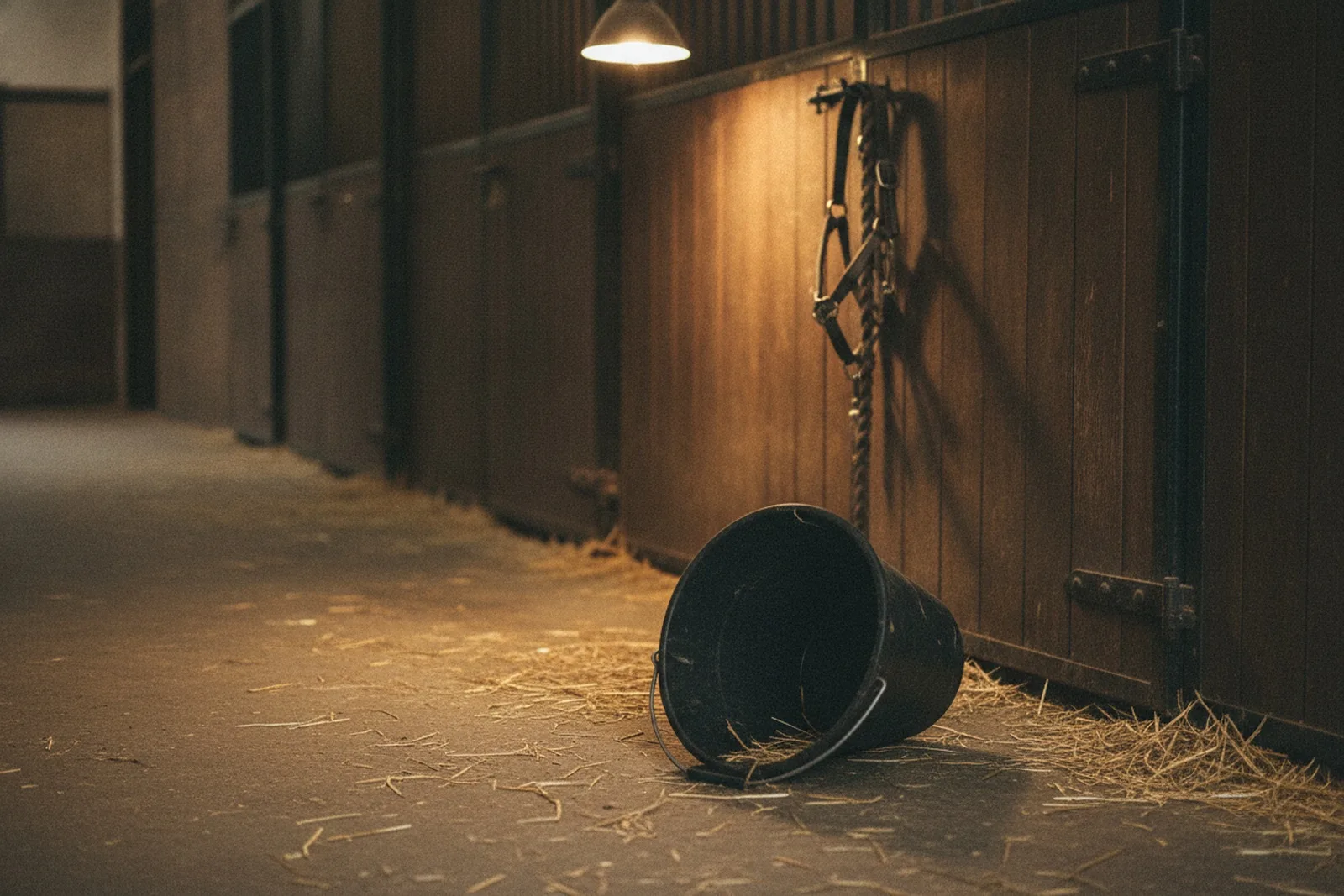
- Clear anything dangerous out of the stall — buckets, a wall-mounted manger, anything to hit on the way down.
- Do not let it throw itself down and roll. A horse going down hard injures itself. Lead it out quietly and walk.
- Walk in hand, do not chase it. Slow walk in a straight line, no lungeing and no trot. Walking is a way of keeping the horse on its feet, not a treatment.
- Take and record pulse, respiration and temperature every 15 to 20 minutes.
- Clear access for the vet's vehicle, put the lights on, get a bucket of warm water ready.
If the horse is standing quietly and not trying to go down, do not march it about for the sake of movement. Walking is for a horse that wants to roll.
What you must not do
I am blunt in this section, because these are the mistakes that lose horses.
Do not give painkillers before the horse has been examined. Bute or flunixin will mask the picture. A horse with a torsion looks comfortable for an hour after an injection, and that hour is the one in which surgery was still an option. What to give and when is a decision the vet makes at that horse, not advice off the internet.
Do not drench with oil, spirits or home remedies. A horse in colic swallows badly, and the liquid goes into the lungs.
Do not give enemas or go into the rectum. The wall tears more easily than you would think.
Do not feed it "to help things move". No bran, no grass, no carrots.
Do not wait until morning. Colic at night is ordinary, and so is a call at night.
Why it happens
The cause is for the vet to establish, but the risk factors are known, and they sit in the owner's territory.
| Factor | What is behind it |
|---|---|
| Abrupt feed change | new hay or grain with no 10 to 14 day transition |
| Not enough water | in winter the water is cold and the horse drinks less |
| Large hard feeds | starch passes on into the hindgut |
| Long gaps between feeds | an empty stomach and acid |
| Sand | feeding off the ground on sandy footing |
| Stabled life | little movement, rare turnout |
| Teeth | feed that is not chewed |
| Parasites | no worming programme built with the vet on egg counts |
| Transport | stress, dehydration, a change of water |
Prevention follows from the list: forage as the base of the ration, feeds split small, water in front of the horse at all times, movement every day, teeth and faecal egg counts on a schedule. Transport deserves its own line — a long haul with a change of water is one of the commonest triggers there is, and a horse that has just travelled is watched closely for the first 48 hours.
The decision you make in advance
One question is settled long before it is two in the morning: does this horse go to a surgical referral or not.
Colic surgery in the United States runs from roughly $8,000 to $12,000, more with complications and a long stay; in Europe from about €5,000 to €10,000. The answer decides whether you load the trailer. Most equine insurance covers colic surgery, and mortality cover normally requires that a vet is consulted before euthanasia. Read the policy before you need it, not after.
Know as well how far your nearest surgical clinic is and whether they take emergencies at night. In rural Spain that can be two hours, and two hours is a factor in the decision.
What I do
I am an owner, not a vet. I do not hand out treatment protocols and I put nothing into anyone else's horse — that is the job of the vet who has examined it.
What I do have for this: the vet's number on speed dial and on the barn door, a thermometer, and the habit of looking at the manger and the muck every evening. I also know how many minutes a vehicle takes to reach Godo PM, and where to put it when it gets there.
Colic is the main reason I do not economise on forage and never change a ration abruptly. What keeping a horse actually costs is in how much a horse costs. If you are buying in Spain, a history of colic and of any abdominal surgery is worth establishing before the deposit — it is a separate question at the pre-purchase exam, and this is how I work.