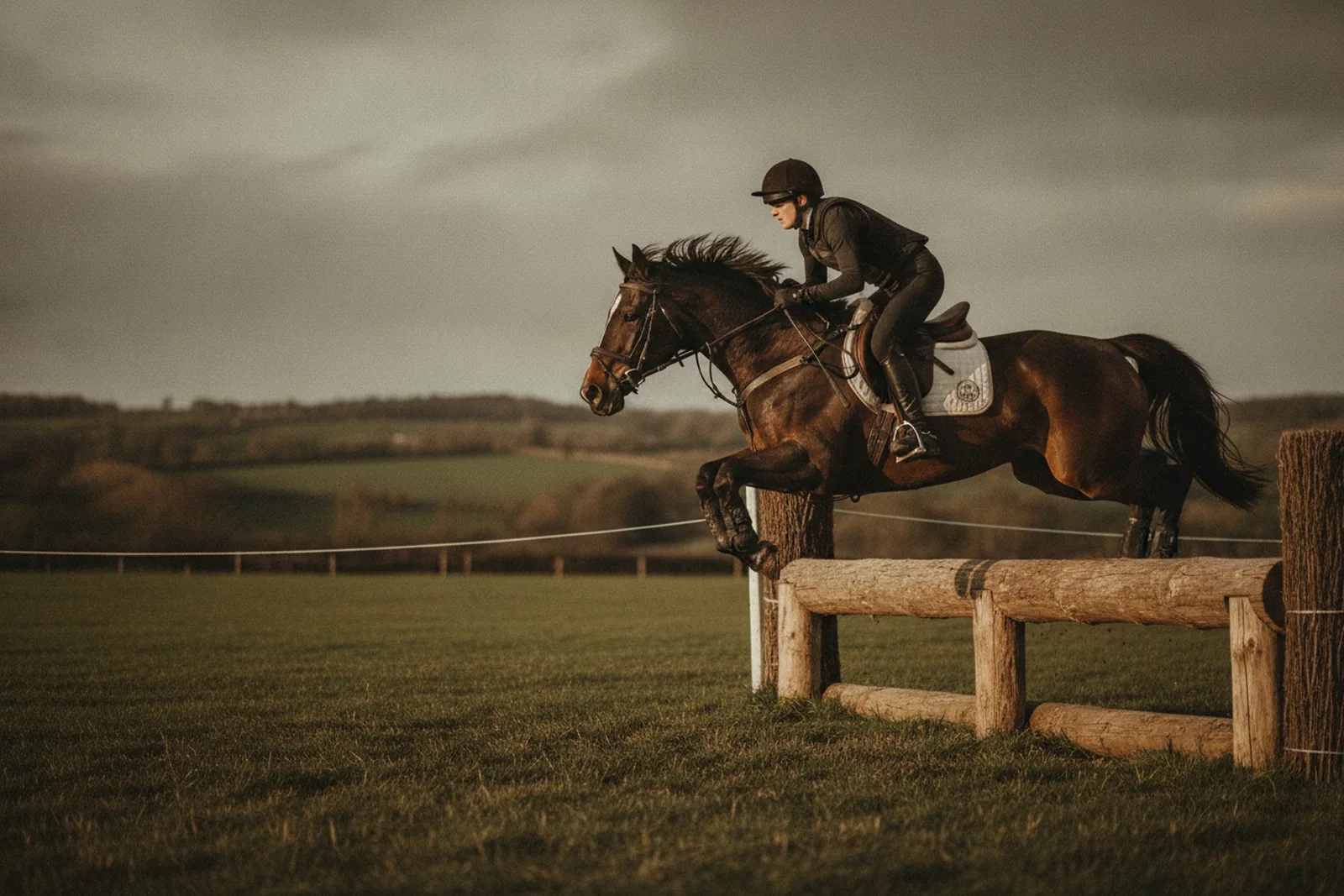
Show jumping: how a round is scored and read
How faults are counted, what a course is built from, where the distances between fences come from, the jump-off, class heights and the horse it takes.
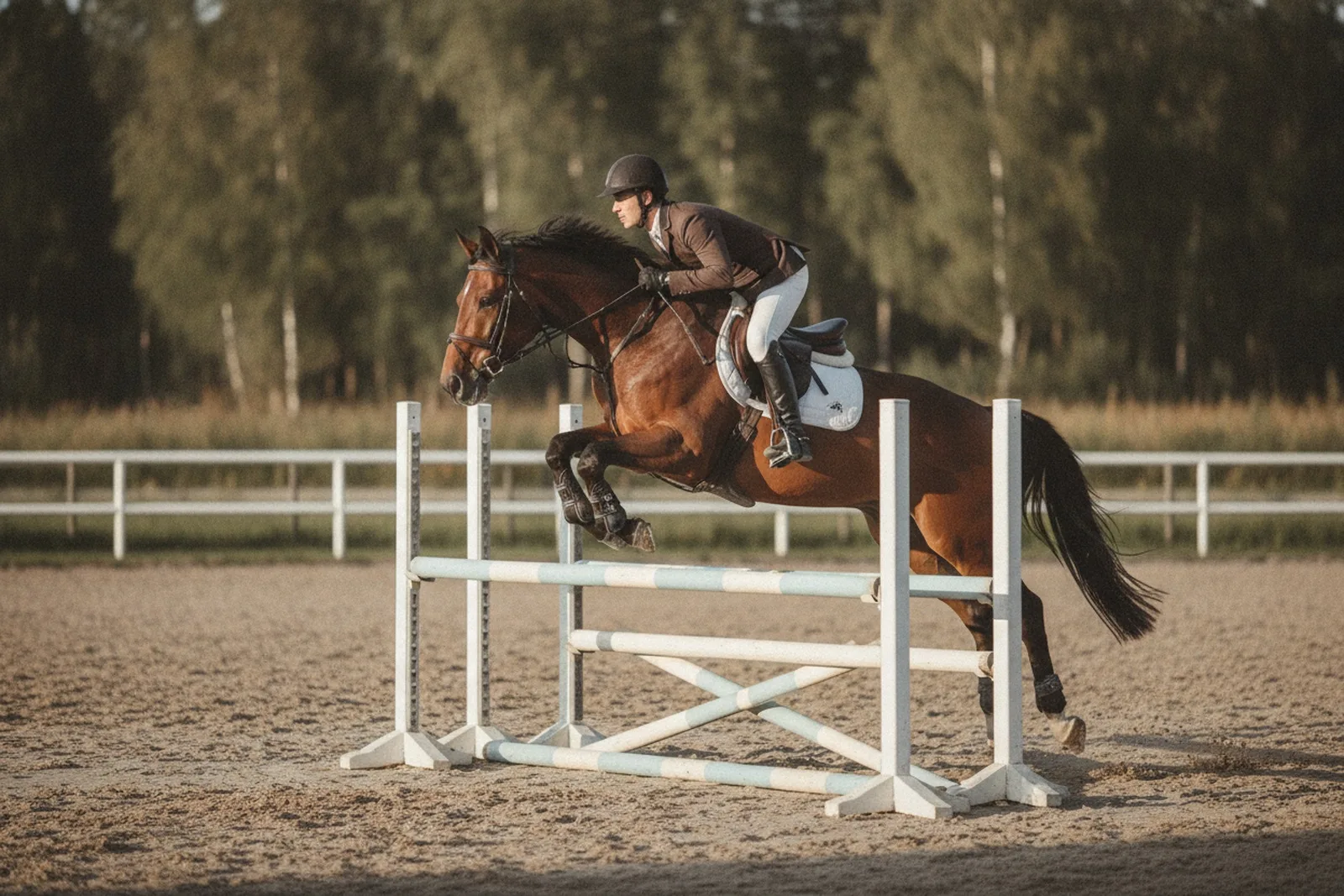
Show jumping is a course of fences ridden inside a set time. The winner is whoever collects the fewest faults, and on equal faults, whoever went faster.
I am not a competitor and not a trainer. I look at jumping as an owner: from the point of view of what kind of horse it takes and what the sport does to him.
How the result is counted
The system is penal. A clear round is zero, and from there the numbers only go up.
| What happened | Consequence |
|---|---|
| Rail down | 4 faults |
| First disobedience (refusal, run-out) | 4 faults |
| Second disobedience on course | elimination |
| Fall of horse or rider | elimination |
| Exceeding the time allowed | time faults on the current scale |
| Jumping fences out of order | elimination |
The exact figures and the time scale are in the current USEF and FEI rules. Regulations are reviewed regularly: what was true three seasons ago may not be true now. That is not a formality — results change on time faults every weekend.
Two more terms worth having. The time allowed is the number of seconds the course designer sets for the distance at the required speed; over it, you collect a fault for each second started. The time limit is twice that, and passing it is elimination.
What a course is made of
Usually 10 to 14 numbered obstacles and 12 to 16 efforts, because some of them stand in combinations.
- Vertical — a fence with height and no width. It forgives the least: there is nowhere for the horse to be wrong about the take-off.
- Oxer — two sets of rails, height plus spread. It asks for a round, scopey jump.
- Triple bar — three sets of rails with ascending height.
- Combination — two or three fences in a row set at one or two canter strides. A mistake on the way in drags the rest of the element with it.
- Wall, water, liverpool, planks — less common, but part of the course.
Distances — the hidden arithmetic
This is the part the spectator never sees at all.
A course designer builds by distance, not by height. The working canter stride of an adult horse on course is about 12 feet, roughly 3.6 m. Everything else follows from that: one stride inside a combination is about 24 to 26 feet, two strides about 34 to 36 feet.
Riders walk the course on foot and count their own strides against it. If five strides are set between two fences and the horse is going in a short canter, he will fit in a sixth and take the rail with him. This is exactly why jumping is won on the flat rather than in the air.
Real distances depend on the height of the class, the footing and the level. The numbers above are bearings for adult horses on good ground.
The jump-off
If several riders go clear, there is a jump-off — a shortened course against the clock. That is where differences in training show: who can cut a corner and lengthen the stride without losing balance, and who was only ever surviving on tidiness.
The jump-off is the most spectacular part and the most costly. It is where horses most often take on more strain than they should.
Heights
Ranges rather than exact steps, because class names differ between the national federations and the FEI.
| Level | Approximate height |
|---|---|
| Introductory and amateur classes | 0.80–1.10 m (2'7"–3'7") |
| Medium classes | 1.20–1.30 m (4'–4'3") |
| Big classes, Grand Prix | 1.40–1.60 m (4'7"–5'3") |
In the United States the jumper divisions are usually named by height — Low, Medium and High Junior/Amateur, then Grand Prix. Anything above 1.50 m is a handful of horses in a country, not a mass sport. Read the current classification in the USEF and FEI rules; it changes.
What the spectator sees and what he does not
Visible: the jump, the rail, the clock.
Here is what is not.
Years of flatwork. The jump is a derivative of the canter. A horse who cannot lengthen and shorten on request will not go clear, however much natural scope he has.
The footing. Deep or churned ground changes the stride and breaks legs. Experienced riders inspect the ground before the class and withdraw if it is bad.
Veterinary control and tack checks. Bits, boots and spurs are checked at shows. That is not a formality: the restrictions exist to rule out training methods based on pain.
Recovery. After a course the horse works several days on a lighter schedule. A competent team builds its season around that.
What I look at when I watch a round
Not the jump. What happens between the jumps.
- The rhythm of the canter. It should be the same from the first fence to the last. If the horse accelerates on his own, the rider is not riding him, he is enduring him.
- The approach. Ears forward, neck free, head not above the bit.
- The landing. The horse should go away straight and drop straight back into rhythm.
- The reaction to a mistake. A rail is not a problem. The problem is a horse who tightens after it and jumps the next two fences out of worry.
- Leaving the ring. A calm walk on a long rein is a good sign.
What kind of horse it takes
Top-level jumping is the product of warmblood breeding: Holsteiner, KWPN, Selle Français, Hanoverian, Belgian Warmblood. They have been selected on the jump for generations, and it shows in the shoulder, the length of body and the way the back works.
A PRE is not a jumper, and I will say that plainly. The Iberian horse is collected, short in the body, high in the step. At amateur heights he jumps perfectly well; at the top of the sport he is not there. The breed was selected for collection and work on the flat, not for power over a wide oxer.
If you are looking for a jumping horse, look in another type. If it is dressage, that is a different conversation and there is a separate article. A round ridden as one phase of three, after the dressage test and the cross-country, is eventing.
What I do here
I do not build courses and I do not teach riders. My part is matching a horse to a job: first I ask how far you intend to go, and only then do I look at movement and jumping ability.
How the search works is on the services page. What happens with a horse long before his first show, at the starting stage, is a job of its own.