Eventing: three phases, three days, one horse
How dressage, cross-country and show jumping add up to one score, what CCI-L and CCI-S mean, why the horse inspections matter and what horse survives it.
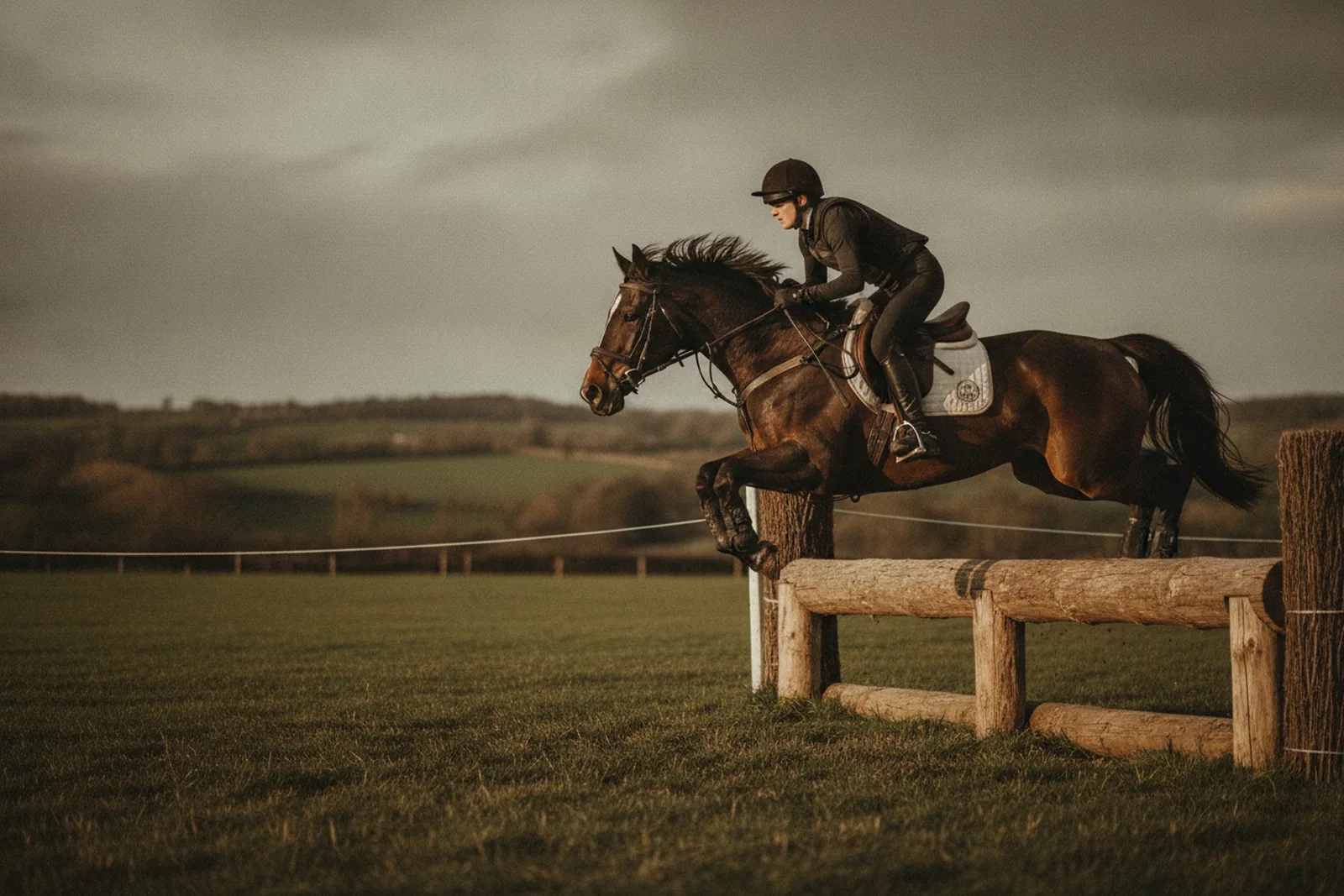
Eventing is the only discipline where the same horse goes through dressage, a cross-country course and show jumping over a few days. You may not swap horses between phases, and that is the whole point of it.
I do not event and I do not prepare horses for it. I watch it as an owner: it is the discipline that shows best what general soundness and fitness are, as opposed to being drilled at one thing.
The three phases and their logic
The order is fixed.
Dressage. The test is simpler than in pure dressage: the aim is not to show a high level but to prove the horse is obedient and adjustable before two hard days.
Cross-country. A course over open ground with solid obstacles and an optimum time. This is the heart of the sport and the main source of risk.
Show jumping. A course in a field or an arena. In itself it is not difficult, but the horse comes to it after cross-country. What is being tested is not the jump, it is the recovery.
That order explains everything else. Eventing does not score three skills, it scores a horse's ability to keep the quality when he is tired.
How the score is built
Penalties from all three phases are added together, and the lowest total wins.
| Phase | Where penalties come from |
|---|---|
| Dressage | the percentage is converted into penalty points |
| Cross-country | refusals, run-outs, falls, exceeding the optimum time |
| Show jumping | rails, disobediences, time |
Under current FEI rules a first refusal at a cross-country obstacle costs 20 penalties, a second at the same obstacle 40, and a third means elimination; going over the optimum time costs 0.4 penalties for each second started. A fall of the horse is always elimination.
The formula for converting the dressage percentage into penalties has been changed before, as have the other coefficients. Check the current FEI, USEA or British Eventing rules before any conversation about numbers.
Levels
The international ladder is written in stars, from CCI1* to CCI5*. Since the 2019 reform each level also carries a format letter: CCI-L is the long format, with a full cross-country distance and the classic three days, and CCI-S is the short format, run over one or two days on a shorter course. A qualification earned at CCI-L does not mean the same as one earned at CCI-S, and the rules say which is required for what.
Below the FEI ladder every country has its own. In the United States the USEA runs Beginner Novice, Novice, Training, Modified, Preliminary, Intermediate and Advanced. In Britain, British Eventing starts at BE80, BE90 and BE100 and rises through Novice and Intermediate to Advanced.
Everything grows together with the level: the height and difficulty of the cross-country fences, the length of the course, the speed, and the demands of the dressage test. As a bearing, solid cross-country fences run from around 0.90 m at the lower levels to about 1.20 m at the top, with far greater spreads. The exact parameters are in the current rulebook.
What cross-country actually is
The obstacles are solid: logs, tables, banks, ditches, water entries, corner fences, combinations on a slope. They do not fall down, so a mistake costs more than it does in show jumping.
That is why frangible technology was pushed into the sport so hard — frangible pins and MIM clips that give way under load and let an element collapse under a heavy strike. It has not made cross-country safe, but it has cut the share of the worst falls.
Water is a chapter of its own. A horse who has not walked calmly into water at home will stop on course.
Speed is not the aim in itself: the optimum time is calculated so that it can be held without chasing the horse. Riders who cut seconds at any price usually pay for it a season later.
The horse inspections
This part of the sport is my favourite, because it is about the horse rather than the result.
Before the competition and again before the final phase there is an inspection — the trot-up. The horse is presented in hand on a hard surface, in walk and trot, and the ground jury with the veterinary delegate looks for lameness and general condition. Fail it and you are out, whatever your placing after two days.
This is the only discipline where veterinarians have the right to end the competition on the rider's behalf. And that is right: a tired horse after cross-country has no business going into a show jumping round.
Trotting up on hard ground to look for lameness is a general rule, not a competition one. Any pre-purchase examination uses the same thing.
What horse survives it
The event horse is the most demanding type in the whole of equestrian sport.
- Blood. There is nearly always Thoroughbred in the pedigree of an event horse: it supplies stamina and the ability to recover.
- Legs. Dry, hard, with dense tendon. On cross-country the legs are the consumable, and a weak tendon ends a career in one season.
- Heart and recovery. There is less than a day between cross-country and show jumping.
- The head. The horse has to go at a solid fence he has never seen before, on request, without an argument.
- Versatility. Which is also the compromise: the event horse is rarely outstanding in the dressage phase.
There are effectively no Iberian horses here, and I am not going to pretend that is an injustice. The PRE was selected neither for stamina across country nor for jumping wide solid fences. What the breed is built for is in dressage explained.
What the spectator sees and what he does not
Cross-country is visible. Here is what is not.
The season plan. An event horse is prepared on a schedule where weeks of work, conditioning and rest are written out months ahead.
Heart rate and recovery. After cross-country the horse is cooled with water, pulse and respiration are taken, and someone watches how many minutes it takes for the numbers to come back to normal. Those numbers decide whether he runs tomorrow.
Legs after the finish. Ice, bandages, an inspection in the morning. Swelling overnight is the end of the competition for that horse.
Attrition. Very few of the horses who start in the sport reach the top levels.
What I do
None of this. I do not prepare or source event horses: it is a separate market with separate expertise, and walking into it from the Iberian side would be pretending.
What I do is find horses in Spain and Germany for quiet work, dressage, breeding and photography: terms here. If you are choosing a discipline rather than a horse, the closest neighbours to this one are dressage and show jumping.