Dressage: how the sport works and where you start
How the percentage is calculated, what the training scale is, how the US and British levels line up with FEI, and where the Iberian horse wins and loses.
Dressage is riding a test you already know, inside a marked rectangle. The test is public. Everyone in the stands knows what comes next. What gets judged is not the idea, it is the execution.
I do not compete and I have no results to my name. I work my own stallion on the flat every day, and I write from there — from the owner's side, where you see what this work is actually made of, one session at a time.
The arena and the letters
Two sizes: 20 x 40 m for the lower tests, 20 x 60 m for the rest. Letters stand around the boundary, and there are invisible points down the centre line. The letters set the geometry: where the diagonal begins, where the transition happens, where the halt is.
Judges sit at one or more points along the short sides and corners. The higher the level, the more of them — three, five, sometimes seven at championships. The same movement is seen from different angles and the marks are averaged.
The point of all that lettering is that a movement is performed at a named spot, not whenever it happens to come together. Half a horse's length late is already a mark gone.
How the percentage is worked out
Every movement is marked from 0 to 10, half marks allowed. Some movements carry a coefficient and count double.
Collective marks are given separately — gaits, impulsion, submission, the rider's position and effect. Their number and weight have been revised more than once, so read the score sheet you are actually riding under.
The points are divided by the maximum available and turned into a percentage. Rough bearings: around 60 % is acceptable work, 65–70 % is good, above 70 % at a serious show is not common.
In eventing that same percentage is converted back into penalty points, which is why the scores there run the other way and the lowest one wins.
The training scale
The German training scale is what dressage is genuinely built on. Six steps, and each one is impossible without the one before it.
| Step | What it means |
|---|---|
| Rhythm | a clean beat in all three gaits, tempo that does not break up |
| Suppleness | the back swings, the neck is free, nothing is braced |
| Contact | even, soft, the horse seeks the rein himself |
| Impulsion | push from behind, energy travelling forward |
| Straightness | the horse works the same way on both reins |
| Collection | hindquarters engaged, forehand lightened, a shorter frame |
The order is not negotiable. A horse collected before he was ever supple looks collected right up to the first extension. After that everything shows: a broken beat, a tight mouth, a tail going like a metronome.
The levels — two ladders and then the FEI
The national ladders do not use the same names, which confuses people who read across borders. They cover the same ground.
| Roughly equivalent | United States (USDF) | Great Britain (BD) |
|---|---|---|
| First tests | Intro, Training | Intro, Preliminary |
| Lateral work begins | First, Second | Novice, Elementary |
| Flying changes, half-pass | Third, Fourth | Medium, Advanced Medium |
| International | Prix St-Georges upward | Advanced, then FEI |
Above the national levels everyone joins the same ladder: Prix St-Georges, Intermediate I and II, then Grand Prix. Half-pass and single flying changes belong to the middle; piaffe, passage, one-tempi changes and canter pirouettes belong at the top. The exact content of each test is in the current USEF, British Dressage and FEI sheets, and those are revised.
Passage and piaffe, by the way, are not separate gaits but movements built on the trot.
Where the rider starts
Not with movements. With position.
The first months go on learning to sit independently of the hands: not holding on by the rein, not losing balance through transitions. Until that exists, every attempt to collect the horse is pressure applied by hand.
The usual order is lunge work without stirrups, then riding independently in three gaits, then the first tests written for newcomers. From first lesson to first competitive test is roughly eighteen months to two years of consistent work.
Tack at a show is regulated: permitted bits, noseband design, spurs, whip. Rules differ between national and FEI competition, and whips are not allowed in some championship classes at all. Day to day the choice is far wider.
What the spectator sees and what he does not
The trot is what catches the eye. Here is what does not.
The walk. It tells you more about a horse's training than anything else in the test. A spoiled, uneven walk is nearly always the result of riding with the hands, and it is the slowest thing of all to repair.
The transitions. Most of the marks are won and lost there, not in the movements.
The mouth. A quiet mouth with even foam means contact. An open mouth, a locked jaw, a head carried above the bit mean resistance, however handsome the horse looks moving.
The years. A Grand Prix horse is usually built between six and ten or twelve years old. The test you watch for six minutes took half the animal's life to assemble.
The Iberian horse in dressage
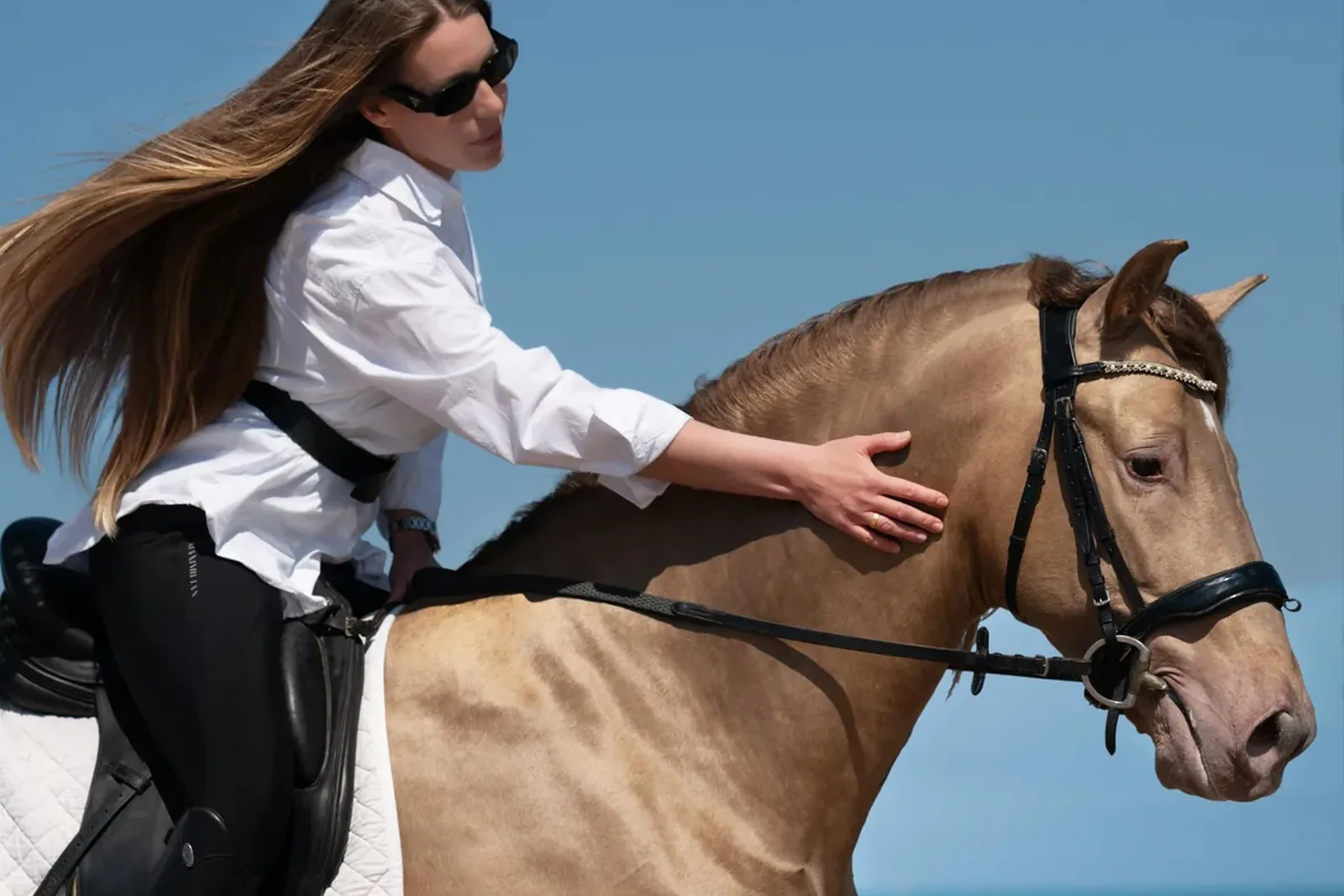
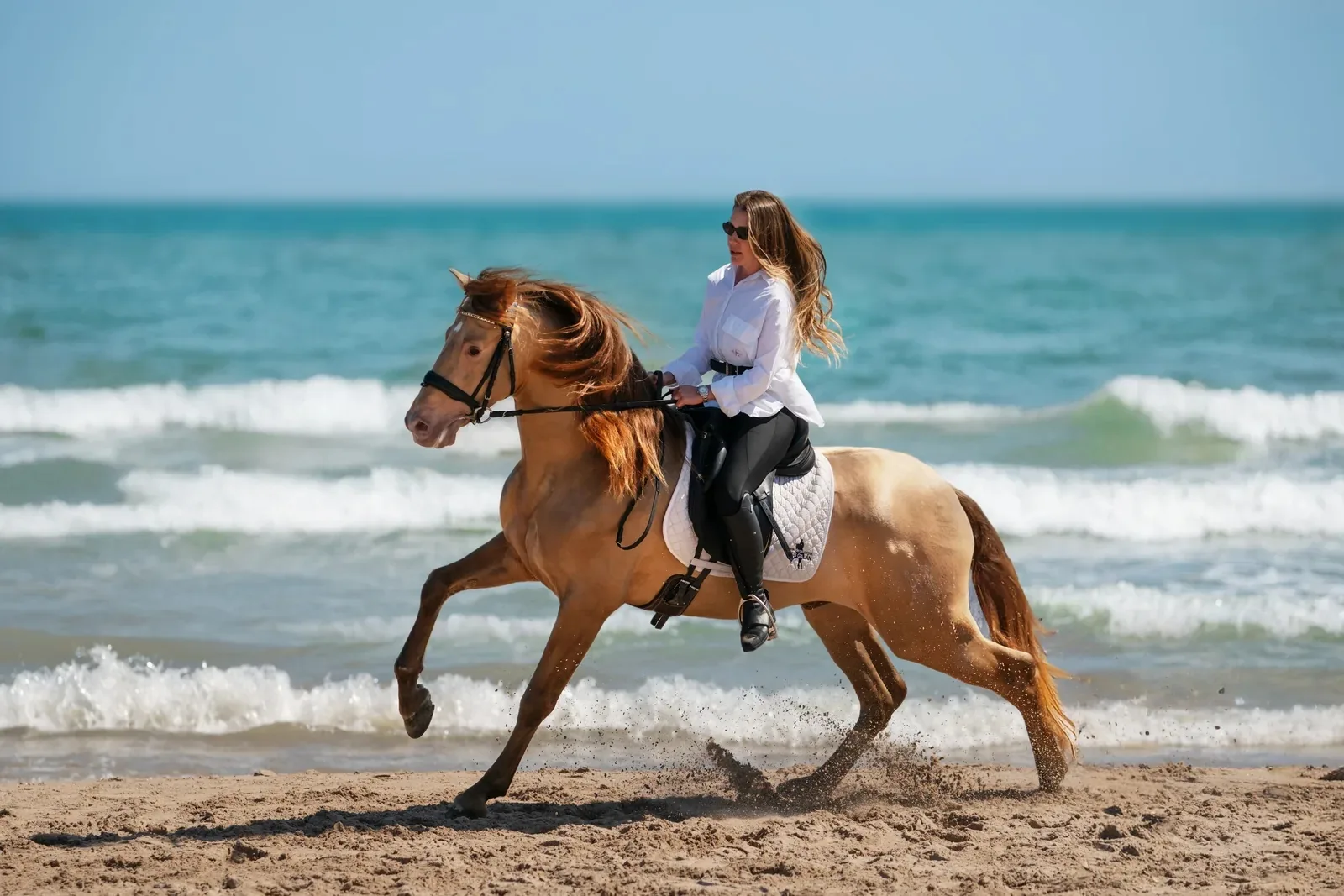
My interest here is practical, because there is a PRE in my yard.
Strengths: collection, piaffe, passage, pirouettes. The build of the hindquarters and a naturally high step give you what warmblood riders spend years chasing. Iberian horses understand collection early and hold it well.
Weakness: the extended gaits. A short body and a high knee do not convert into ground cover. In the extensions a PRE routinely loses marks where a Dutch or German horse gains them.
The practical conclusion: an Iberian horse is competitive at the higher levels, where there is a lot of collection, and is at a disadvantage at the lower ones, where there is a lot of extension. That is worth knowing before you buy, not after your first score sheet.
The breed in detail is in the Andalusian horse (PRE). How temperament affects trainability is in temperament before buying.
What I do
I do not train and I do not compete. I work Godo PM on the flat daily, and that is basic work without which a horse falls apart physically — not preparation for a show.
What I do professionally is find horses in Spain and Germany. When the brief is dressage, I look at three things first: the purity of the beat, the quality of the walk, and how the horse answers pressure. Terms are on the services page. Godo PM is here.