How to approach a horse without getting hurt
Where a horse's blind spots are, which side to come from, how to enter a stall or a turnout field, what to do around a horse that is not yours.
A horse weighs half a tonne and sees the world differently from you. It does not strike out of malice. It startles at whatever appeared without warning, and it moves away whatever it cannot make sense of. Almost every injury in a barn happens on the ground rather than in the saddle, and almost all of it happens in the first five seconds of contact.
Here is how to come up so the horse can see you, and what to do once it has already tightened.
What she sees and what she does not
The eyes sit at the sides of the head, so the field of view is close to a full circle. There are two places where a horse is blind: directly in front of the nose and directly behind. On top of that, she judges distance poorly with what only one eye is seeing, and often swings her head to look at a thing with the other eye.
Hence the plain rule: come to the shoulder, slightly to the side and slightly in front — not head-on, and never from behind. From there she sees all of you, and you are out of the arc of a hind leg. What she is telling you while that happens is in horse body language.
The order of an approach
- Voice first. Say something quietly from several metres away. Sound reaches her before you get into her field of view.
- Wait for the head or an ear to turn. That is the confirmation you have been noticed.
- Walk to the shoulder on a curve. Not fast and not creeping. A person creeping reads as a predator.
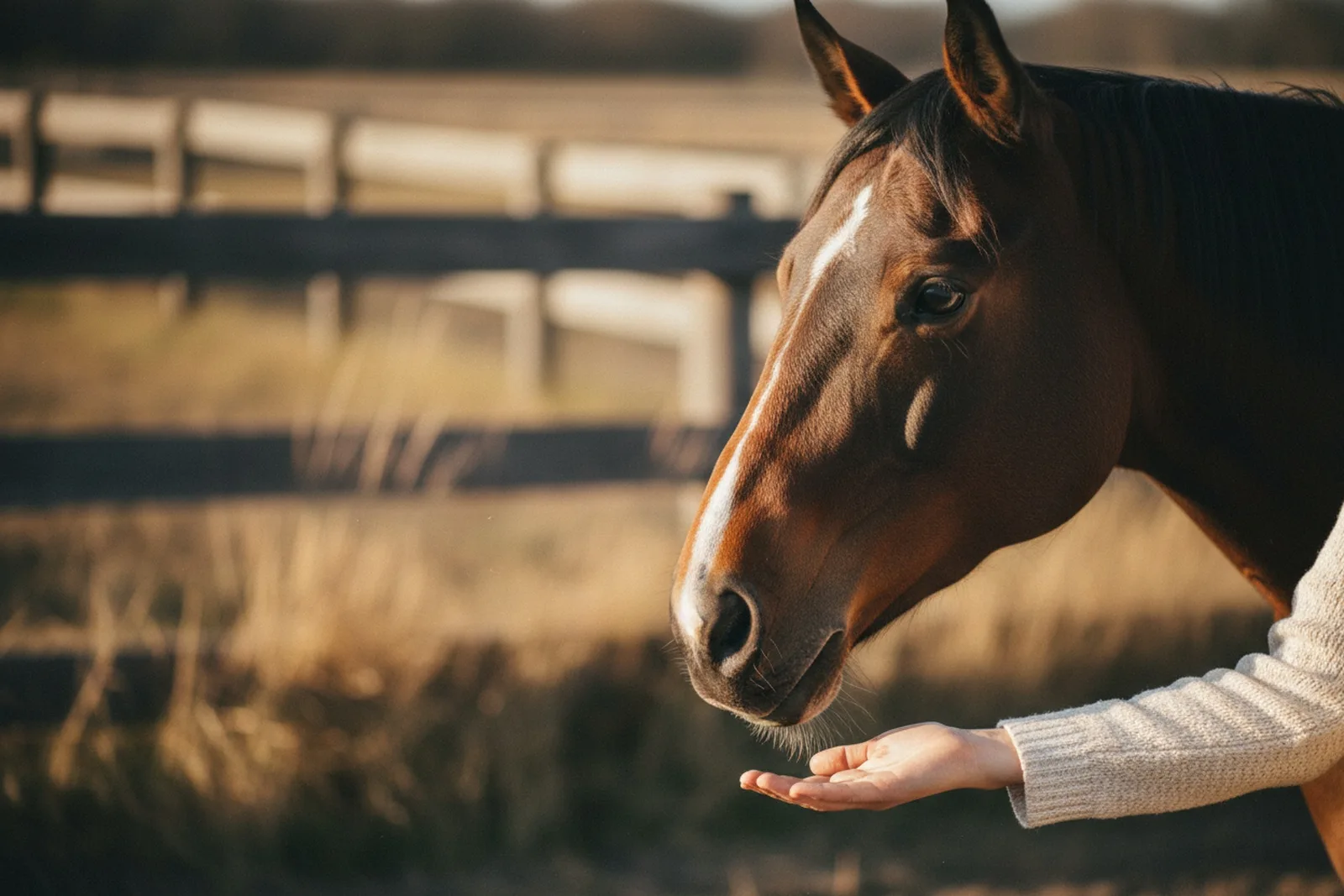
- Hand open, palm down, held low. Do not reach straight for the muzzle. The forehead and the nose are sensitive, and plenty of horses defend them.
- First contact on the neck or the shoulder. With a flat hand, not fingertips.
- Then stay at the shoulder, not in front of the chest and not by the quarters.
Three places, three approaches
| Where | Do | Do not |
|---|---|---|
| Stall or box | speak from the door, wait until she has turned to you, come in to the shoulder | walk in silently, squeeze past the quarters |
| Crossties, hitching rail | come from in front and to the side, inside her view | duck under a lead rope, come up from behind |
| Turnout field, group | walk in with purpose, go to your own horse, keep the others in view | carry feed in your hands, run, turn your back on the group |
The stall is the most dangerous of the three. There is little room, the horse has nowhere to go and you end up between her and a wall. If she is standing with her quarters to the door, do not go in until she has turned around. Call, knock on the door, wait.
In a field the risk is rarely your own horse. It is the others. Hand-feeding in a group is never worth it: horses fight over a treat in a field, and the person in the middle is the one who gets caught.
What to read on the horse
Three things at once. It takes a second.
- Ears. On you or forward is fine. Pinned flat to the neck means leave. One ear back means she is listening to you, and that is not a threat.
- Quarters and a hind leg. Swinging the hindquarters towards you, a leg cocked and lifting, a tail slapping the sides — that is a direct warning.
- Head and neck. A high head, a tight neck, white showing round the eye: fear. A neck stretched towards you with a soft eye: interest.
Separately: a horse that pins her ears at feeding time or as the girth comes up is more often telling you about pain than about her personality. That is a call to the vet and a look at the saddle, not a training matter. The difference is in horse temperament.
Never
- Never pass close behind. If you have to go round, go either two horse lengths clear or right up against her, with a hand on the quarters and your voice going — then she knows where you are, and a kick never gathers force.
- Never appear suddenly round a corner, from behind a trailer, from behind a stack of hay.
- Never run alongside a horse or past a row of stalls.
- Never reach for the muzzle first.
- Never hand-feed somebody else's horse. Or your own, out in the field.
- Never wrap a lead rope round your hand. Not once, not for a second. That is how people lose fingers.
- Never crouch down beside a horse. You cannot stand up and get out of there.
- Never stand on the line between the horse and the exit, in a stall or in a field.
A horse that is not yours
One rule: ask the owner first, then everything else. Do not touch, do not feed, do not open the door, do not photograph with a flash.
After that the same steps, only slower. You do not know whether this horse bites, whether she is frightened of men in caps, whether she has had a head injury. A sign on the door is not always there. The habits always are.
With children the rule is harder: a child goes up to a horse only with an adult, and only to a horse that adult knows.
When she will not let you catch her
A common enough situation. She walks off in the field, she turns away in the stall.
Do not chase. A chase turns it into a game you lose every time.
Change your line. Walk on a curve, slightly past her rather than at her, with your eyes off her. A straight line and a straight stare read as pressure.
Stop before she leaves. The moment you reach the point where she tightens, stand there, turn a little away, and let her come to you.
Look at what happens the rest of the time. A horse that will not be caught is usually objecting not to you but to what comes afterwards: work that hurts, or a headcollar that pinches.
Do not finish on a fight. Even if all you did today was put the headcollar on and let her go again, that beats catching her by force.
If the behaviour goes past shyness — real threats, kicking, biting in earnest — that is a separate subject and patience is not what solves it: a horse that bites or kicks.
How it works with mine
Godo PM is a stallion, and I keep the distance tighter with him than I would with a gelding. My one rule has not changed in years: he knows where I am, every second. I speak on the way in, I put a hand on his neck, and I do not walk behind him without saying so.
I do not teach and I do not give groundwork lessons. But when I photograph horses on the coast, the first twenty minutes never go on frames. They go on the horse getting used to a person with a camera standing close. How those sessions are built is on the services page.